AI in Rail Session Explores Safe, Real-Time Operations
7/9/2026
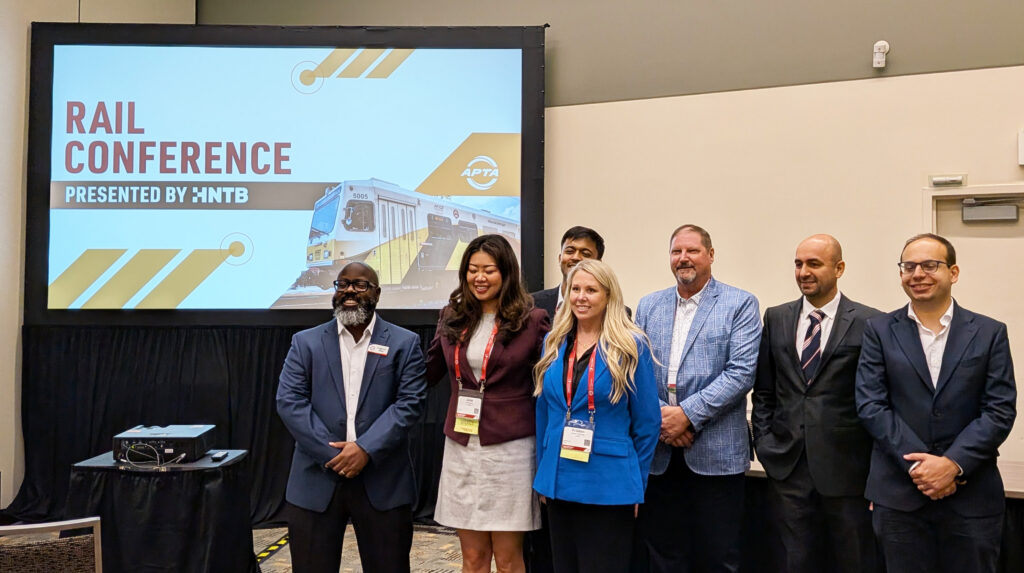
In one of four final sessions at the APTA 2026 Rail Conference, a standing room audience heard from four organizations on how agencies can implement AI to increase efficiency while maintaining trust, data integrity, and human oversight.
Moderator David Jackson, managing partner, transportation industry lead at Gartner Consulting, Inc., framed AI adoption as both a technology and workforce issue, emphasizing that agencies must build AI literacy, establish policy, and rethink processes to make AI useful in everyday work. “AI adoption is a human problem,” Jackson noted, pointing to the need for an AI-ready culture and stronger employee confidence in using the tools.
Kevin Pellegrini, owner of TransitShine Solutions LLC, outlined varying levels of AI integration, from basic stand-alone uses such as research to more advanced applications that can query large datasets, support chatbots, and help build or test operational systems. While AI is strong at research and comparing options, Pellegrini said that the technology still struggles with reliability and open-ended tasks, particularly when faced with large amounts of context. AI implementation must take data privacy and cybersecurity into account, and humans need to ensure data quality and governance.
Jane Huang, industrial engineer and Kristen McDonald, principal, digital advisory and transformation, both with Jacobs, focused on AI-powered program optimization. They contrasted traditional project delivery—often reactive, siloed, and overloaded—with AI-enabled approaches that are proactive, connected, and optimized. Their presentation highlighted how AI can help agencies reuse knowledge across projects, identify risks earlier, and reduce cost by making siloed data more visible.
Amin Kalbasi, principal systems engineer at Parsons Corporation, examined safety engineering in the era of big data and AI. He explained that AI models can vary, evolve over time, and be difficult to explain. They can also help identify safety risk with more 99 percent accuracy. When asked if the rail industry can learn from the safety standards being applied for autonomous vehicles, he replied, absolutely, yes.
Closing the session, Tejas Agarwal, CEO of Scout Robotics, looked at Edge AI in transit, describing how revenue fleets can be transformed into smart safety monitors. Small devices mounted on trains collect data that Edge AI can process directly on the vehicle, reducing reliance on constant connectivity and enabling real-time insights. Potential applications include monitoring tie conditions, identifying missing components, thermal monitoring, detecting and counting assets, spotting obstacles, and assessing clearance.
During the panel discussion, speakers returned to common themes of data standards, storage, transfer, risk, and governance. Looking ahead, they encouraged agencies to ask whether new AI-enabled systems are making operations safer, how to sustain momentum beyond pilot projects, and how APTA committees can help the industry continue learning together.
See APTA’s Primer on Artificial Intelligence and Machine Learning in Public Transit.