Aging Population Drives Accessibility Innovations in Transit
5/26/2026

Population trends in the U.S. suggest a busy future for public transportation. Most young people aren’t getting driver’s licenses, families are moving to suburbs, and older adults are aging in place while driving less. Add in the needs of culturally diverse populations, and the age of transit workers—43 percent are 55 or older—and it’s easy to forecast huge demand ahead.
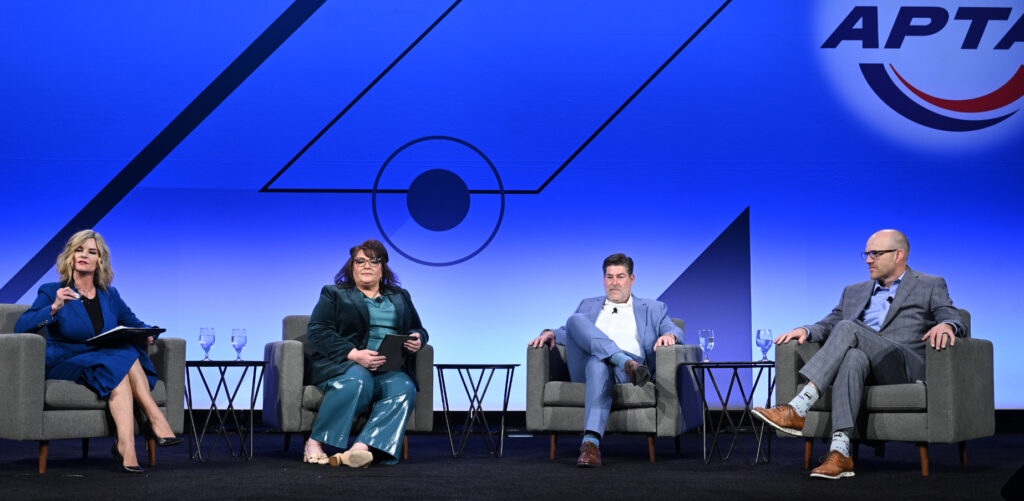
The impact of these trends on transit was the focus of the “Demography to Destiny: What Current Demographic Trends Tell Us” General Session at APTA’s 2026 Mobility Conference, moderated by Karen E. Philbrick, executive director, Mineta Transportation Institute.
Philbrick asked her panelists, a director of accessible services, a capital planning director, and a shared-ride service founder, how demographic trends are shaping their work.
Eileen Collins Turvey, APTA Access Committee secretary and director of TriMet Accessible Transportation Programs, said Portland, OR, is already seeing a surge in the 55+ population. Major bus routes have tripled ADA pass-ups, and projections suggest paratransit demand will increase 80 percent in the next 20 years.
“Older adults travel differently,” said Collins Turvey, sometimes needing more accessibility aids, and “We cannot paratransit our way out of this demographic shift…. We must invest in truly accessible fixed-route networks now, design systems around lifelong mobility… and treat aging demographics as a core strategic planning assumption.”
TriMet has creatively moved some paratransit riders to a new, free fixed-route service and is using Falcon devices to read aloud digital content, for riders with poor vision or using translator apps.
Utah started planning for growth in the 1990s, said Jon Larsen, chief capital services officer of host agency the Utah Transit Authority (UTA), with a nonprofit, Envision Utah, to establish values and direct growth, leading to the state’s blueprint of city and neighborhoods centers near transit, Wasatch Choice Vision.
“This started as kind of a fringe thing, and now it’s fully baked into how we do our planning,” Larsen said. With full participation from the state DOT, UTA, counties and cities, “It’s really helped us to integrate our land use decisions with our transportation planning.”
Jeff Maltz, co-founder & CEO of SilverRide, spoke to the importance of transportation on health. “When people stop driving, we like to say when they hit their driving ‘retirement,’ they reduce their outings by 59 percent,” he said. That isolation leads to increased depression and mortality. “So, life just gets terrible when you get isolated, and transit is really a big part of the solution to that problem.”
This session was sponsored by Keolis NA.
View more images from the Mobility Conference and International Bus Roadeo.