Transit Leaders Discuss World Cup Cost, Lessons, and Keys to Success
10/14/2026
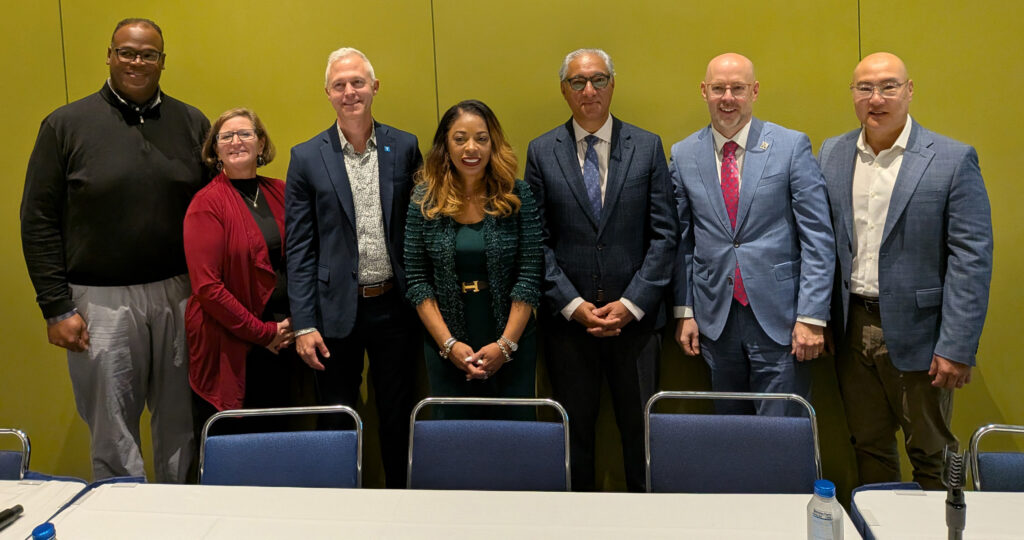

The experiences of six public transit agencies providing record-breaking World Cup service may have differed based on agency size and operating environment, but their central message was the same: no transit provider can deliver a successful mega-event alone.
That was the consensus among panelists speaking at APTA’s 2026 TRANSform & EXPO session, The FIFA Games: A Transit Report Card in Chicago, IL. Moderated by APTA Secretary/Treasurer Jannet Walker-Ford, business line executive for advisory and planning at WSP, the session brought together leaders from agencies serving the summer’s World Cup host locations of Atlanta, GA; Boston, MA; Dallas, TX; Los Angeles, CA; New Jersey/New York; and Vancouver, Canada, joined by Mark Bathrick, FTA’s associate administrator for the Office of Program Management. The session was sponsored by Cubic.
Start Early—and Plan Together
Walker-Ford asked the panelists about planning; specifically, what helped the most and what they wished they had done. LA Metro CEO Stephanie Wiggins said her agency started planning two years ahead of the tournament and conducted monthly readiness reviews. Her chief lesson was to involve regional transit partners in tabletop exercises sooner. LA Metro ultimately coordinated with 11 other agencies during planning, while its operating plan drew support from 12 agencies and a contractor.
For NJ TRANSIT, President and CEO Kris Kolluri described an unprecedented level of coordination with Amtrak, New York City, and other partners. Beginning in January, the agency held meetings three times a week and closed action items only when every participating organization agreed they were resolved.
Serving Vancouver, Canada, TransLink organized its work around transit planning, safety and security, communications, and logistics. CEO Kevin Quinn said exercises tested heat, station closures, crowd conflict, and leadership succession. The objective was not to predict every possibility, he said, but to build a team able to respond to what could not be predicted.
That adaptability became critical when actual travel patterns diverged from forecasts. MARTA GM/CEO Jonathan Hunt said Atlanta’s Fan Fest proved more popular than expected, creating queues, street closures, and disruptions to streetcar service. He said earlier negotiations with labor partners could have helped extend connecting bus service after late matches.
Mary Ellen DeFrias, administrator of Greater Attleboro-Taunton Regional Transit Authority (GATRA), which served the Boston venue, said the agency should have started working with stadium staff sooner to understand needs for crowds arriving via public transportation as opposed to driving. She said, “We moved more people on public transportation than that stadium has ever had.”
Rich Andreski, president of Trinity Metro, which served the Dallas/Fort Worth venue, suggested transit agencies be involved during the bid and initial event planning stages.
Protecting Everyday Riders
In discussing operations and logistics, panelists stressed that expanded event service could not come at the expense of riders who depend on transit every day. LA Metro added 330 buses with help from partner agencies and a contractor, while keeping its cancellation rate at approximately one percent, Chief Operations Officer Conan Cheung said. The agency also accelerated rehabilitation work at 51 rail stations before the tournament.
Smaller systems relied on mutual aid. GATRA borrowed staff, vehicles, and drivers from regional transit authorities across Massachusetts, while maintaining service in its 30 communities. Trinity Metro secured charter buses for the full event period, giving the agency capacity to handle uncertain demand and test attention-getting service—including a shuttle for international visitors to Buc-ee’s.
MARTA filled 6,400 ambassador shifts with more than 700 volunteers and obtained public safety support from Denver’s Regional Transportation District. TransLink built a high-capacity shuttle to its Fan Fest and used its automated SkyTrain system to stage frequent trains and clear platforms quickly.
Who Pays for the Surge?
The panelists discussed the substantial costs that were carried by the agencies to achieve success. Many said they were grateful for FTA’s award of $100 million to the 11 U.S. host cities, which helped reduce debt. FTA’s Mark Bathrick noted the federal funding and a toolkit to streamline assistance. He said that big multinational events are a great opportunity for public transportation to put its best foot forward.
To help cover costs, agencies looked toward partners and took different creative approaches. Quinn said that TransLink received more than $20 million from Canadian provincial and federal partners to cover additional service. The agency also launched a soccer ball fare product, which sold out in seven hours.
NJ TRANSIT combined federal support, a special event fare (which was not without controversy), and nearly $10.5 million in sponsorship revenue. Kolluri said its remaining loss on a $62 million budget was $3.98 million.
Like TransLink, LA Metro generated revenue through a World Cup-oriented fare card as well as through park-and-ride fees and sponsorships. GATRA received state reimbursement and used a private partner’s ticketing platform, noting that the agency avoided a financial loss. Jonathan Hunt said that federal support combined with additional fare revenue helped reduce the amount of MARTA’s debt from the event. However, he noted the human cost of surge operations, with the associated long hours that can put strain on the workforce.
Several panelists advocated building transit into event economics from the outset. Wiggins urged integrated event-and-transit ticketing while Kolluri called on event organizers to share more of the cost. Hunt suggested an industrywide effort with ticketing companies to make integrated fares easier to implement across agencies.
The panel’s report card was ultimately positive as the agencies delivered huge crowds safely, which would not have been possible without teamwork among both staff and partners.