Federal Partners Outline Priorities for Transit, Passenger Rail at TRANSform
10/22/2026
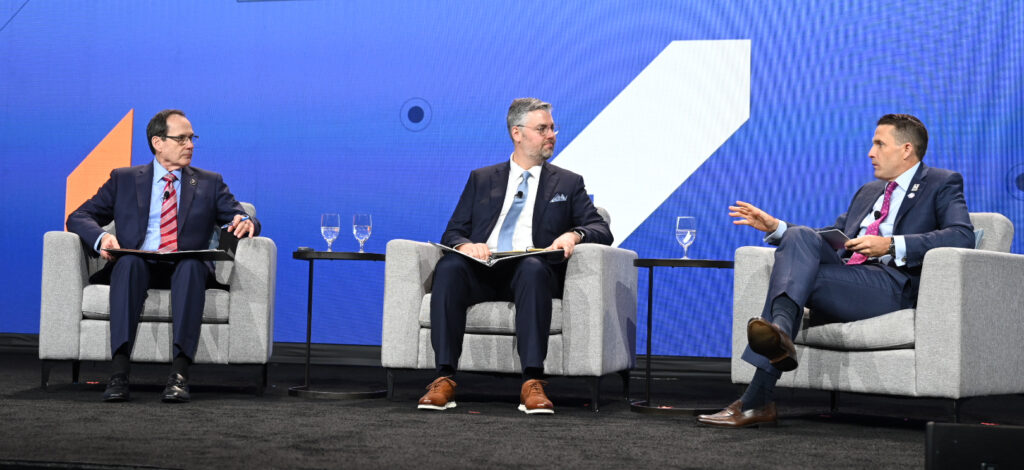

FTA and FRA leaders outlined their agencies’ priorities for safety, infrastructure investment, project delivery, and passenger growth during the Federal Partners Update session at APTA’s recent TRANSform & EXPO in Chicago, IL. Matthew Cahill, FTA Acting Deputy Administrator and Chief Counsel, and Rusty Roberts, FRA Senior Policy Advisor, described complementary approaches to strengthening transportation systems across the United States, with an emphasis on accountability, cost effectiveness, and expanding capacity to meet growing demand.
Moderated by Randy Clarke, APTA Vice Chair and General Manager and CEO of the Washington Metropolitan Area Transit Authority, the discussion highlighted both agencies’ commitment to safety and infrastructure improvements, alongside efforts to streamline federal oversight and encourage innovation.
FTA Emphasizes Investment, Accountability, and Rider Experience
Cahill began by recognizing the industry’s role in delivering eight billion transit trips in 2025, or approximately 21 million trips daily. In fiscal year 2026, FTA awarded more than 2,000 grants representing $20.5 billion in investments and closed out more than 2,300 grants for completed projects.
Recent and planned investments span multiple modes. FTA announced $166 million for rail vehicles, $233 million through its All Stations Accessibility Program, and $665 million for 14 ferry projects. The agency was also reviewing another $610 million in bus and bus facility grants, including low- and no-emission vehicles. Cahill said FTA intends to continue investing in accessibility, with approximately 77 percent of rail stations currently accessible under the Americans with Disabilities Act, and a goal of reaching 100 percent.
Improving the rider experience is central to the agency’s approach. FTA’s Transit Moves America initiative uses a public data dashboard to highlight safety and security, reliability, cleanliness, accessibility, and real-time service information. Cahill said the initiative is intended to improve performance measurement and help agencies benchmark results and strengthen accountability.
Safety remains FTA’s foremost priority, encompassing enforcement, worker protection, and passenger security. Cahill cited reductions in assaults on transit workers and passengers during the first half of the year, while emphasizing that persistent security challenges and worker fatigue require continued attention. The agency is promoting measures including driver barriers, de-escalation training, improved policing, and stronger rail worker protection practices.
FTA also intends to streamline its Capital Investment Grants (CIG) program, improve transparency in federal funding decisions, and prioritize projects that deliver measurable benefits. Recent commitments include $1.28 billion for Utah’s FrontRunner 2X project and $150 million for Los Angeles’ Vermont Avenue BRT project.
“We really want to partner with APTA,” Cahill said, particularly on efforts to stabilize vehicle procurement costs and increase competition among suppliers. He noted that U.S. rail transit projects can cost 1.5 to two times more than comparable projects in Canada and Europe. Reducing costs, simplifying regulations and accelerating reviews, he argued, would allow more projects to be built and more communities to be served.
FRA Focuses on Rail Growth, Safety, and Organizational Reform
Roberts characterized the United States as being in the midst of a passenger rail renaissance, with growing ridership creating an urgent need for additional capacity. Drawing on his experience at Brightline, he argued that neither the public nor private sector should be expected to finance major passenger rail projects entirely on its own. Greater use of public-private partnerships could help distribute risk and support development.
He also discussed efforts to restructure Amtrak’s operations to improve efficiency and accountability. The proposed approach would establish distinct management functions for infrastructure, passenger services, and rolling stock, with clearer responsibilities and separate financial reporting. The goal is to identify inefficiencies, improve customer service, and manage equipment more effectively. Amtrak also faces a significant capacity challenge, making fleet replacement and additional trainsets essential.
Safety is another major FRA priority. The agency has awarded billions of dollars in grants, including $356 million for grade-crossing safety improvements in Florida, where crossing collisions and trespass incidents remain serious concerns. Roberts noted that railroad worker injuries have declined substantially over the decades, but fatalities at highway-rail crossings have moved in the wrong direction.
FRA is also pursuing regulatory changes and new technologies to improve safety. Roberts stressed the importance of maintaining a steady domestic rail manufacturing pipeline, arguing that consistent demand is necessary to sustain American train-building capabilities.
“Now they’re coming, so we better build it,” Roberts said, referring to the growing number of people choosing passenger rail and the need to expand the network to accommodate them.
A Shared Agenda for the Future
Although FTA and FRA oversee different parts of the transportation system, their priorities converge on several fronts: safer operations, more efficient use of federal funding, improved infrastructure, and greater capacity. Both officials emphasized that public investment must produce tangible results, whether through better transit service, more reliable passenger rail, or reduced safety risks.
The broader takeaway is that rising demand creates an opportunity for the industry, but realizing it will require more than funding alone. Agencies and their federal partners must control costs, strengthen accountability, improve project delivery, and rebuild manufacturing capacity. As Cahill and Roberts made clear, expanding transit and passenger rail will depend on delivering projects that provide measurable public benefits while making the nation’s transportation systems safer, more reliable, and better equipped for future growth.