From Planning to Polling: Legal Insights for Transit Ballot Measures
By Nicole Watkins | 5/29/2026

NICOLE WATKINS
Research Director
Center for Transportation Excellence
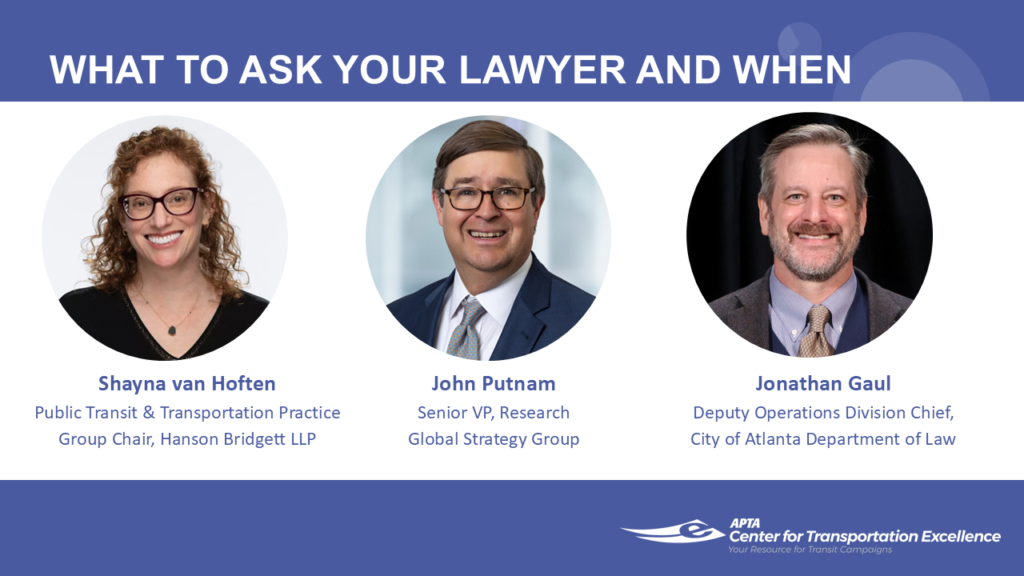
As transit agencies across the country look to fund critical infrastructure and service improvements through the ballot, one thing is clear: a successful campaign begins long before voters explore the issues on their ballot. During “Route to Transit Ballot Success: What to Ask Your Lawyer & When,” the recent webinar hosted by APTA’s Center for Transportation Excellence (CFTE) and moderated by CFTE Executive Director Jessica Grennan, legal experts from across the country shared practical lessons on navigating the legal, political, and strategic realities behind transit ballot initiatives.
A key message that emerged from the discussion was that legal strategy must start early. “Legal counsel should be involved from the very beginning,” said Shayna van Hoften, Public Transit & Transportation Practice Group chair at Hanson Bridgett LLP. “If you’re looking at a tax and you haven’t called your lawyer yet, you’re already late.”
Panelists emphasized that agencies must first determine whether they have the legal authority to pursue a ballot measure. It is also crucial to understand the specific rules governing funding mechanisms, tax structures, and ballot language in their state, because what works in one may not work in another.
Speaking of different rules, the discussion also highlighted the need to clearly separate agency activities from campaign activities. In many states, public agencies are prohibited from using public resources to advocate for or against a ballot measure, even while educating the public about the proposal. Attorneys can help agencies avoid compliance issues by establishing those boundaries early.
John Putnam, partner at Kaplan Kirsch LLP and former general counsel for USDOT, stressed the importance of understanding the legal “rules of the game” before crafting a measure. That preparation includes assessing political feasibility, identifying legal constraints, and considering long-term risks tied to project execution and public trust.
Polling, stakeholder outreach, and community engagement are more than campaign tactics, they’re essential for evaluating whether a measure is realistic and sustainable. Jonathan Gaul, deputy operations division chief for the City of Atlanta Department of Law, encouraged agencies to utilize these types of resources to remain pragmatic about both voter appetite and their own capacity to deliver.
The importance of long-term thinking is a recurring theme throughout all of CFTE’s webinars. Ballot initiatives are not isolated campaigns; they shape public trust for years to come. Panelists encouraged agencies to consider how future economic conditions, competing measures, or project execution hiccups could affect their ability to fulfill commitments made to voters.
For APTA members, the webinar reinforced a central lesson: successful transit ballot initiatives require more than public support. They depend on early legal guidance, strategic coordination, realistic planning, and a clear understanding of both the opportunities and risks involved. As agencies continue exploring local funding solutions, these lessons will remain critical to building durable and trustworthy transit investments.
A recording of this webinar, and past webinars, is available on APTAU.
Save the Date: Learn more about this and other questions related to the transit ballot measure process at APTA’s Transit Ballot Initiative Workshop, December 14-16 in Nashville, TN.