The Future Is Here: And How to Use It
5/21/2026
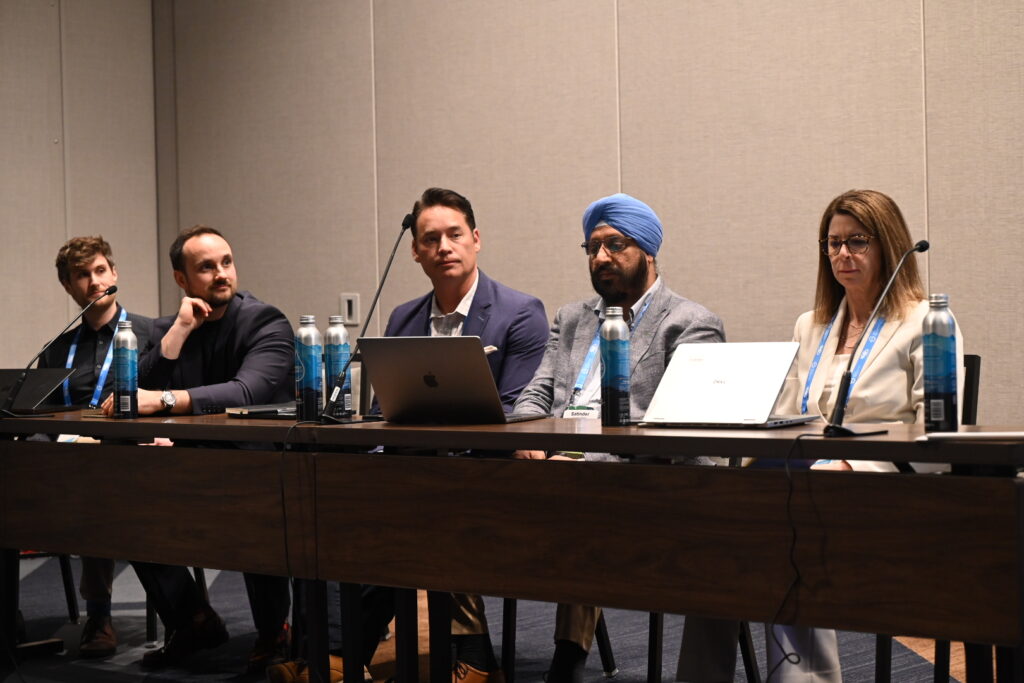
At the APTA 2026 Mobility Conference panel “AI, AVs, Oh My! Keeping Humans in the Loop,” moderator Shannon Bailey, director-national sales, GILLIG, and five industry leaders largely agreed that artificial intelligence is no longer a future concept for public transportation, it is already reshaping operations, customer service, maintenance, scheduling, and autonomous vehicle deployment. However, panelists repeatedly emphasized that AI must remain grounded in human oversight, strong governance, and clearly defined operational goals.
Bailey framed the discussion by noting that transit agencies must evaluate AI not just by efficiency gains, but also by “safety, equity, accessibility, reliability, transparency, and public trust.” She stressed that the central issue is no longer whether AI will affect transit, but “how do we use it responsibly, practically, and in ways that improve service.”
Stephanie Doughty, VP of professional services, MV Transportation, focused on implementation strategy, arguing that agencies should first understand their data, workflows, and organizational processes before deploying AI. She warned against treating AI as a stand-alone solution and instead urged agencies to “embed AI invisibly” within existing workflows. Doughty also emphasized ongoing human oversight, saying agencies must “balance automation with human judgment through intentional checkpoints throughout that workflow itself.” Using MV Transportation’s driver recruitment and retention efforts as an example, she said agencies should begin with a clearly defined operational problem rather than adopting AI for its own sake.
Satinder Bhalla, principal at TransSIGHT LLC, echoed that sentiment, describing AI as an evolution of transit’s longstanding use of modeling and analytics. “It’s not about are we using AI or not, it’s about how can we better use AI?” he said. Bhalla stressed that agencies must prioritize use cases carefully and establish governance structures to avoid fragmented deployments. He also highlighted AI’s future potential to personalize customer experiences proactively rather than reactively.
For Toby McGraw, chief revenue officer, Beep, the discussion centered on autonomous vehicles and the operational systems surrounding them. He argued that public perception often focuses narrowly on vehicle automation itself, while the larger challenge is safely automating the broader transit experience. “Even at the highest level of automation, there continues to be these edge cases where humans in the loop really need to help make this decision,” McGraw said. He described AI applications ranging from predictive fleet availability to onboard safety sensing and remote command centers that synthesize data from vehicles and infrastructure.
Sam Haas, director of solutions engineering, RideCo Inc., reinforced the panel’s consensus that AI deployments require careful process analysis and measurable goals. He compared AI systems to onboarding a new employee: “You have to onboard it. You have to give it attention, you have to invest resources in making it better.” Haas stressed that agencies should define success metrics before deployment and avoid adopting “solutions looking for problems.”
Cameron Stone, director of product management, Spare, focused on the importance of integrated systems and governance. He argued that fragmented software ecosystems limit AI’s usefulness because “AI is only as useful as the context that it can see.” Stone shared examples of AI assisting customer service staff and rural transit operations, while emphasizing that final decisions still require human review. “We still need a human in the loop to review this information and use their judgment,” he said.
Despite differing perspectives, the panelists consistently agreed on several key themes: AI should solve clearly identified operational problems; agencies must maintain strong governance and transparency; data integration is essential; and human oversight remains indispensable. The overarching takeaway was that AI’s value in transit lies not in replacing workers, but in enhancing human decision-making, improving efficiency, and expanding service capacity while preserving safety and public trust.
This session was sponsored by AECOM.
View more images from the Mobility Conference and International Bus Roadeo.