When Cellular Becomes Transit Infrastructure
By Mike Curnow | 4/15/2026
ICS Cybersecurity Operations Architect
AECOM
Member of APTA’s Transit Cyber Security and Signals and Communications Working Groups

Communications Trust and Operational Dependency in Modern Transportation Systems
A single commercial carrier outage today can disrupt real‑time bus tracking, onboard fare transactions, video backhaul, and system monitoring across an entire transit fleet. What was once supplemental connectivity has quietly become mission‑critical. Modern transit operations now depend on cellular networks in ways that shape service reliability, customer experience, and operational visibility.
Across many agencies, commercial cellular networks provide a large portion of this connectivity. Bus fleets operating across large service areas often rely on cellular links as the primary communication channel between vehicles and central systems. Passenger information displays, monitoring devices, and intelligent transportation equipment may also depend on cellular networks to transmit operational data.
Over time, this connectivity has evolved from convenience to a foundational operational capability. In practical terms, cellular networks have become part of the infrastructure environment that supports modern transit operations.
Cellular Connectivity in Transit Operations
Transit systems today operate as distributed digital environments. Vehicles, roadside equipment, stations, and operations centers participate in a continuous exchange of information that supports daily service delivery. These capabilities span multiple modes, including buses, light rail, commuter rail, and paratransit fleets. Cellular connectivity enables functions such as:
- Fleet location and dispatch systems
- Automated fare collection
- Vehicle diagnostics and maintenance telemetry
- Passenger information services
- Onboard connectivity
- Video and security system communications
- Safety and fire detection systems
Cellular Networks as Operational Infrastructure
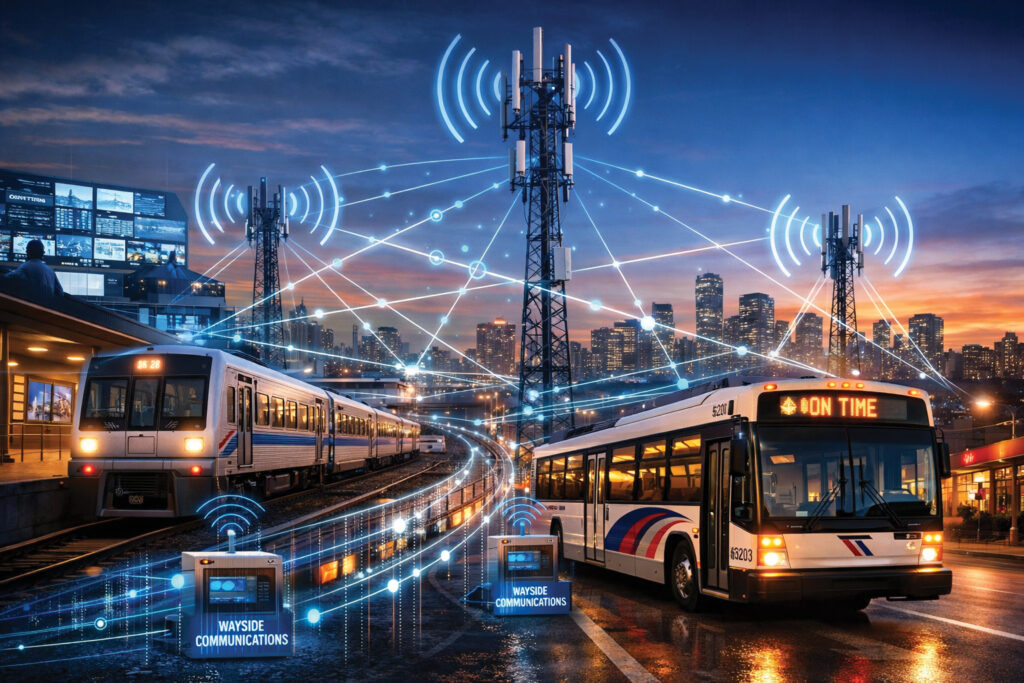
Historically, transit agencies built and managed their own communications infrastructure through dedicated radio systems, agency fiber networks, and signaling communications. Today, agencies increasingly rely on commercial cellular networks to connect mobile assets with centralized operational platforms. This model offers clear advantages. Cellular networks provide wide-area coverage, support large numbers of connected devices, and allow agencies to deploy connected technologies without building extensive communications infrastructure.
However, it also introduces an important operational consideration: part of the communications environment supporting transit operations now exists outside agency control. From a systems perspective, this places cellular connectivity among the external dependencies that influence transportation system reliability.
The Transit Radio Environment
Transit systems operate along predictable geographic routes. This includes bus corridors, rail alignments, and maintenance routes. Vehicles repeatedly travel through these corridors, interacting with surrounding infrastructure each time they traverse the route. Recognizing this dependency allows agencies to evaluate communications reliability as part of overall system resilience.
From a wireless communications perspective, these routes create consistent mobility environments in which vehicles repeatedly connect to nearby radio infrastructure. Transit agencies devote significant attention to maintaining the physical infrastructure along these corridors, including roadways, signals, power systems, and track structures. The wireless environment surrounding these same corridors is often less visible within traditional transportation planning.
Yet as transit operations become increasingly connected, the characteristics of that wireless environment can influence operational performance. Connectivity interruptions can affect fleet visibility, passenger information systems, diagnostics reporting, and other services that depend on reliable communications links. While most disruptions result from routine network conditions such as congestion or coverage limitations, the broader radio environment can also influence device connectivity behavior.
Communications as a Transportation Infrastructure Layer
Transportation systems are often understood as layered infrastructure environments. Physical infrastructure, vehicles, power systems, and communications networks all contribute to operational performance. As cellular connectivity becomes embedded in transit operations, wireless communications represent another infrastructure layer influencing system behavior.
Understanding these dependencies helps agencies incorporate communications reliability into broader resilience planning. A temporary loss of connectivity may not stop service entirely, but it can reduce operational visibility. This has the potential to affect vehicle location reporting, passenger information updates, and remote monitoring capabilities.
What Transit Agencies Should Consider
As transit systems continue to modernize, agencies may benefit from evaluating how cellular connectivity fits within their infrastructure strategy. These steps can help agencies better align communications planning with overall transportation system resilience.
Key considerations include:
- Recognize cellular connectivity as operational infrastructure, treating it as a core element of the communications environment rather than auxiliary technology.
- Understand communications reliability along transit corridors, including if coverage, congestion, or handoff patterns may impact operations.
- Incorporate connectivity dependencies into resilience planning so operational risks tied to commercial networks are accounted for in continuity strategies.
- Evaluate redundancy and fallback communications options, ensuring critical systems maintain minimal functionality during outages or degraded service.
- Assess corridor‑level radio frequency coverage and reliability patterns using drive testing or device telemetry to identify where connectivity degrades along bus and rail routes.
- Identify which systems degrade gracefully versus fail outright during connectivity loss, ensuring safety‑critical functions maintain appropriate fallback behavior.
- Evaluate contractual expectations with commercial carriers, including uptime considerations, service‑level agreements, and use of priority or preemption services for essential transit data.
- Consider multi‑carrier or blended connectivity architectures to reduce single‑provider dependency and improve availability.
- Leverage gateways or modems that support cell‑selection controls, such as the ability to lock to a specific cell or PCI (Physical Cell Identifier) to reduce unexpected handoffs and improve both security and connection stability for stationary equipment deployed in stations, yards, and wayside facilities.
Looking Ahead
In today’s connected transportation systems, cellular networks are no longer simply supporting technology. They are becoming an essential layer of modern transit infrastructure. Wireless connectivity has become an integral component of modern transit systems. Cellular networks enable real-time operational tools that support connected vehicles, passenger information systems, and digital fleet management.
As this dependency grows, understanding the role of communications infrastructure within the broader transportation environment becomes increasingly important and critical to agency safety, security, and resiliency.