Transit Safety Requires More Than Policies and Procedures
10/20/2026
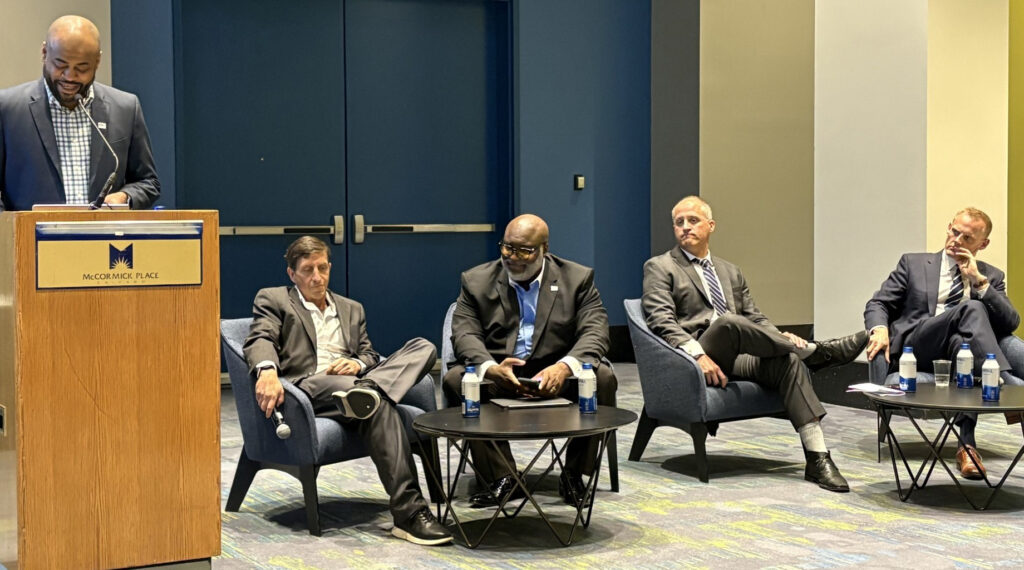

Safety must be embedded in every aspect of a public transportation organization, from leadership and employee communication to training, accountability, and daily operations. That was a central message of Improving Transit Safety: The FTA and Chief Safety Officer Perspective, a panel at APTA’s recent TRANSform & EXPO in Chicago, IL. Axis Communications sponsored the session.
Panelists were Joe DeLorenzo, Associate Administrator for Transit Safety and Oversight and Chief Safety Officer at FTA; Tremell Brown, Deputy CEO of VIA Metropolitan Transit, San Antonio, TX; and Jayme Johnson, Executive Vice President and Chief Safety and Readiness Officer at the Washington Metropolitan Area Transit Authority (WMATA), and Jeffrey Hulbert, Vice President of Safety at the Chicago Transit Authority (CTA).
Although the speakers approached safety from different perspectives, they shared a common conclusion: Effective safety programs depend on an organizational culture in which employees communicate openly, take responsibility, and continually learn from experience.
For DeLorenzo, communication is the foundation of a strong safety culture. Policies and procedures cannot prevent incidents if employees do not understand them, feel unable to raise concerns, or fail to share information across organizational boundaries. “You can have all the policies and procedures in the entire world, but if you’re not communicating them and if you’re not having communication going back and forth, it’s not going to work,” he said.
DeLorenzo emphasized that safety leaders must advocate for safety throughout their organizations and create an environment where employees can report problems, including fatigue. Employees may hesitate to disclose that they have not slept adequately, even when fatigue could affect their ability to operate a vehicle safely.
Safety Management Systems (SMS) provide an important framework for identifying hazards and developing mitigations, but they cannot succeed in isolation. Agencies also need accountability, effective communication, and a willingness to evaluate whether safeguards are working.
Brown illustrated how safety becomes particularly important when agencies expand services, accelerate projects, and bring new employees and leaders into the organization.
VIA is advancing its first Advanced Rapid Transit (ART) project, the Green Line, while implementing its Better Bus Plan. Brown described an organization undergoing significant change, including improvements in employee recruitment and retention and faster implementation of service improvements.
That progress, however, creates potential risks. New employees may lack an understanding of transit operations, while incoming leaders may underestimate the coordination required to deliver service safely. Large initiatives affect departments throughout an agency, requiring everyone to understand their responsibilities before service begins.
Brown posed a fundamental question: “Does every new employee feel safe raising a concern on day 1, and does someone act on it?”
He stressed that safety cannot belong exclusively to the safety department. Drivers, mechanics, planners, dispatchers, and other employees must recognize safety as part of their jobs. Agencies must reinforce that expectation through onboarding, cross-departmental coordination, emergency preparedness, and recognition programs that encourage employees to report hazards.
Johnson and Hulbert, drawing on their experiences at WMATA and CTA, focused on making safety a defining organizational value rather than a separate function.
Both acknowledged the hazards confronting transit agencies, including derailments, trespassing, and assaults. Yet they argued that preventing future incidents requires looking beyond individual events to examine organizational culture, management practices, and opportunities to improve.
Hulbert described how CTA established regular forums for departments to review hazards, corrective action plans, and incidents. Rather than focusing solely on what went wrong or who was responsible, these discussions also examine what worked, why it worked, and how successful practices might benefit other departments.
Such structured discussions make information sharing routine and reduce reliance on individual safety personnel to chase down updates or coordinate corrective actions.
Johnson emphasized the importance of professionalizing operations throughout the organization. WMATA, he explained, has opportunities to strengthen employee training and better equip supervisors and managers to identify hazards, reinforce expectations, and hold employees accountable.
As he put it, “safety isn’t just something that’s out there and is a separate activity or entity. It’s what we do every day.”
A safety department can provide expertise and oversight, but it cannot substitute for competent management and safe practices across the organization.
Together, the speakers offered a consistent message for transit leaders. A strong safety culture requires more than written policies, formal safety systems, or responses to serious incidents. It depends on communication that flows in every direction, employees who feel empowered to speak up, leaders who respond to concerns, and systems that turn lessons into action.
Agencies must also recognize that operational excellence and safety are inseparable. Better training, clearer responsibilities, effective coordination, and consistent follow-through help prevent the conditions that lead to incidents.
The ultimate test is not simply whether a safety policy exists or an investigation identifies a cause. It is whether the organization learns, improves, and makes safer practices part of its everyday work. As the panelists demonstrated, safety is not a task assigned to one department; it is a commitment shared across the entire organization.