Touring WMATA’s Integrated Command and Communications Center
By Anna Lisi | 3/11/2026
Director, Publications and Senior Managing Editor, Passenger Transport
APTA
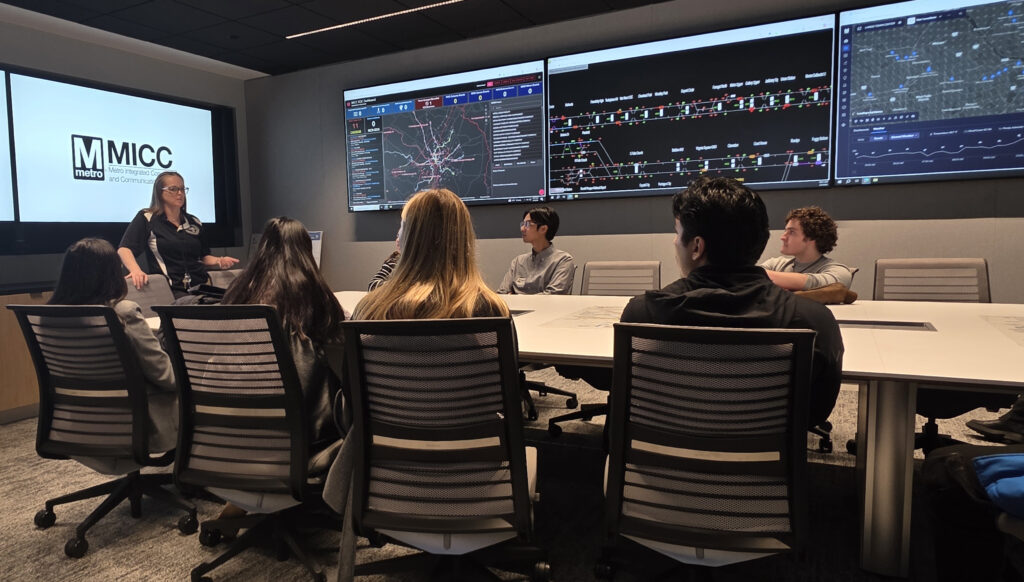
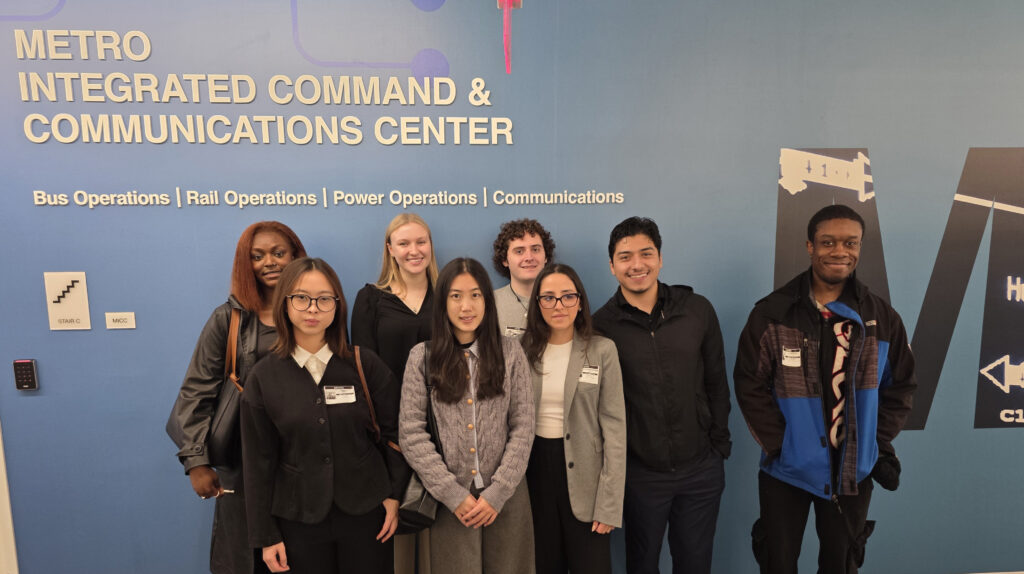
I had the pleasure of joining APTA’s interns for a tour of Washington Metropolitan Area Transit Authority (WMATA/Metro)’s Integrated Command and Communications Center. The operations center is the eyes and ears of the public transit system that moves over half a million people a day through 98 stations across Washington, DC, Virginia, and Maryland. In a city that hosts the most national security events in the United States, the 24/7 center’s dashboards track everything from the precise location of every train in the system to elevator and escalator outages to localized changes in the weather.
The center opened in Alexandria, VA, in 2023 near the Eisenhower Metro station. It is the home of WMATA’s data center, cybersecurity operations, bus and rail video teams, communications, and administrative support. Signage within the halls echo the agency’s “one Metro” mantra. As explained by General Manager and CEO Randy S. Clarke at the building’s opening, “Instead of managing service from separate control centers, we can coordinate together in real-time, working as a unified team to provide customers with clear, consistent messaging.”
With more than 13,000 employees, not including contractors, coordination becomes a necessity. That is where the command center comes into play. At the front of the room is a massive screen mapping every train in the system—red and green lights indicate train status. Other dashboards track bus service, power, and emergency alarms. There’s a hotline to every police and fire department in the region. There’s a communications section that handles the agency’s social media accounts and respond to customer issues. In a separate room, the agency monitors its 32,000 CCTVs, which are used for safety, security, and crowd management.
Staff across the system can message the command center to call attention to any issue. The agency even has its own weatherperson. Any change in conditions can require a change in operations, such as slowing the trains in high wind and knowing when to apply deicers.
Our tour guide, Jennifer Burke, is strategic manager for transit operations in the command center. She began her career at WMATA/Metro 11 years ago as an administrative assistant in the parking department and has worked her way up since then. The agency offers career paths in nearly every field from management to health to even the arts. She described her job as fun and constantly offering something new.
After seeing the state‑of‑the‑art command center, it’s easy to understand why someone would want to be part of an agency that seamlessly coordinates the transportation so many of us depend on every day.