The Tech Corner: BAE Systems, Inc.
10/5/2026

SPECIAL ADVERTISING SECTION
Innovation Brings Key Maintenance to the Transit Garage
The Modular Accessory Power System is keeping repairs local
Transit bus fleets are built to keep communities moving, and that means keeping buses on the road. When a bus goes down, getting it back into service quickly becomes the priority. How quickly that happens can depend on several factors, including one critical question: Can the repair be handled in-house, or does the equipment need to be sent out for service.
Over the past 30 years, BAE Systems has encouraged transit bus support staff to keep repairs on property with on-site technical expertise. Our Modular Accessory Power System (MAPS) builds on that legacy by giving end users greater ability to service power electronics in the field. This is a very distinctive, value-added capability backed by BAE Systems expertise and support.
Whether an operator performs repairs independently or needs additional support, BAE Systems can provide the right level of assistance, helping reduce reliance on off-site repairs to get buses back into service more efficiently.
“We are rolling out a process where transit agencies can service MAPS on their own, right in their own maintenance facility,” said Allison Vaughan, manager of customer service and support for BAE Systems.
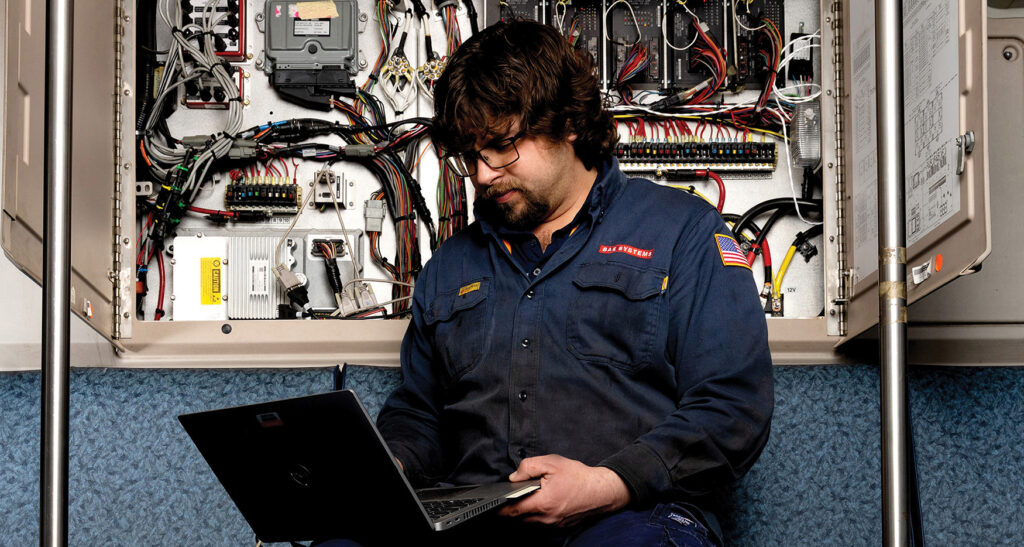
The approach gives trained transit technicians the ability to open the system, find the problem, replace the affected section and return the equipment to service without shipping the entire unit away for repair.
“This is an important next step for modular power electronics,” said Vaughan. “It transfers service capability to the people who operate and maintain the buses every day.”
MAPS provides power conversion for electric accessories on transit buses. Instead of multiple components, cooling loops, unnecessary cabling, and many interconnections, MAPS uses a modular architecture made of cohesive functional sections, within a single component and cooling system to meet all the bus’s accessory needs. Each section performs a specific job, and the configuration can be tailored to the vehicle.
Now, BAE Systems is now extending that modular approach to the way MAPS is serviced.
Instead of treating the power inverter as a component that must be removed and shipped elsewhere when service is needed, trained technicians can access the system in the field. If one section needs attention, they can address that section rather than replacing or shipping the entire unit.
For a transit agency responsible for keeping hundreds of buses moving, the difference can be significant. A repair that once involved removing a complete unit, packaging it, shipping it and waiting for its return can instead become a local maintenance job. This reduces shipping, shortens turnaround times, and potentially makes repairs more cost effective.
But making sophisticated power electronics serviceable in a transit garage takes more than designing a product that can be opened. Technicians also need to understand what they are seeing and how the individual sections work together.
A critical advantage of MAPS is its diagnostic or trouble shooting capability. Technicians can connect to MAPS and troubleshoot down to the individual module level, pinpointing the source of an issue before ordering replacement hardware. This allows operators to identify exactly which module needs attention, rather than replacing or returning the entire system. This helps streamline repairs, manage costs, and gets buses back into service faster.
BAE Systems has also developed an expanded MAPS training unit that physically separates the individual sections, giving technicians a clear view of the components normally contained inside the unit. Instead of learning from a closed piece of equipment, technicians can see and work with each section of the unit hands-on, helping them build the skills needed to diagnose issues and troubleshoot MAPS at the module level.
“That capability is increasingly more important as electrification changes the work being done inside transit garages,” said Vaughan. “High voltage systems, electric accessories and sophisticated power management technology are becoming more common in facilities that have traditionally focused heavily on mechanical equipment.”
Ultimately, bringing service capability closer to the customer is about keeping buses available for service. By combining a modular design with hands-on training and field service capability, BAE Systems is bringing more of the repair process directly into the transit garage, helping agencies reduce downtime, control costs and keep buses where they belong: on the road.

BAE Systems, Inc.
Allison Vaughan
Manager of Customer Service and Support
E: allison.vaughan@baesystems.us