Super Bowl LX Transit Service Was a Success! Now Let’s Do It Again … Six More Times!
By Janice Soriano-Ramos | 4/30/2026
JANICE SORIANO-RAMOS
Sr. Transportation Planner
Santa Clara Valley Transportation Authority
San Jose, CA
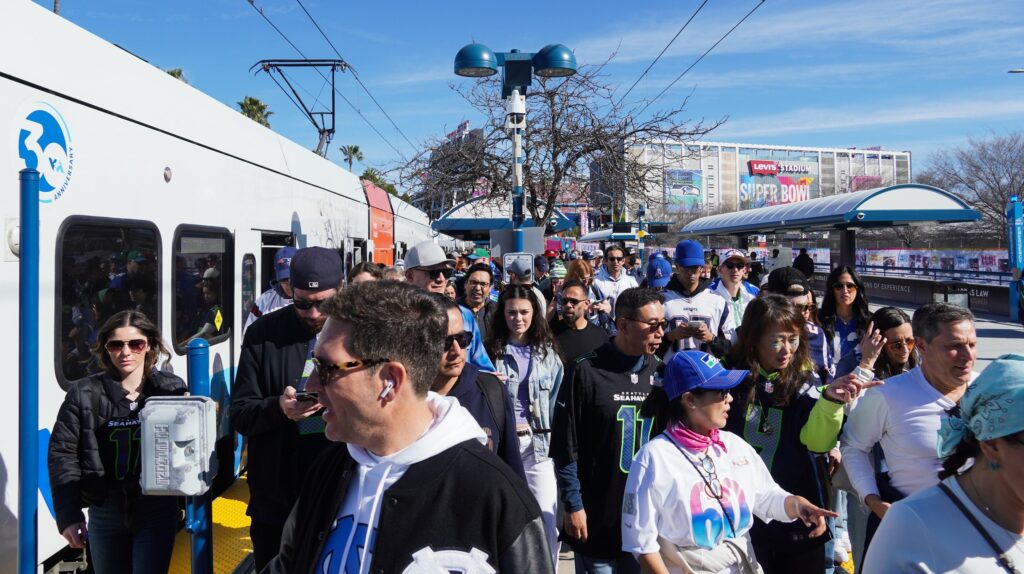
Major events are often described as stress tests for transit systems, but for agencies with direct stadium service, they are also opportunities to refine a playbook. For the Santa Clara Valley Transportation Authority (VTA), more than a decade of serving Levi’s Stadium has yielded critical lessons in scalability, coordination, and customer experience which were lessons that were put to the test and expanded upon during Super Bowl LX.
VTA has been the only transit agency directly serving Levi’s Stadium since it opened in 2014. Its Great America light rail station, located directly in front of the venue, was purpose-built to accommodate the surges associated with NFL games, concerts, and other major events. That foundation, combined with prior experience hosting a Super Bowl, positioned VTA well, but the scale and security requirements of this year’s event demanded new approaches.
On a typical event day, riders from across the Bay Area connect to VTA light rail via Caltrain, BART, ACE, Capitol Corridor, and local VTA bus routes. For the Super Bowl, those connections required deeper regional coordination to align service delivery with heightened security and national attention. Record crowds were expected, and the reality exceeded expectation.
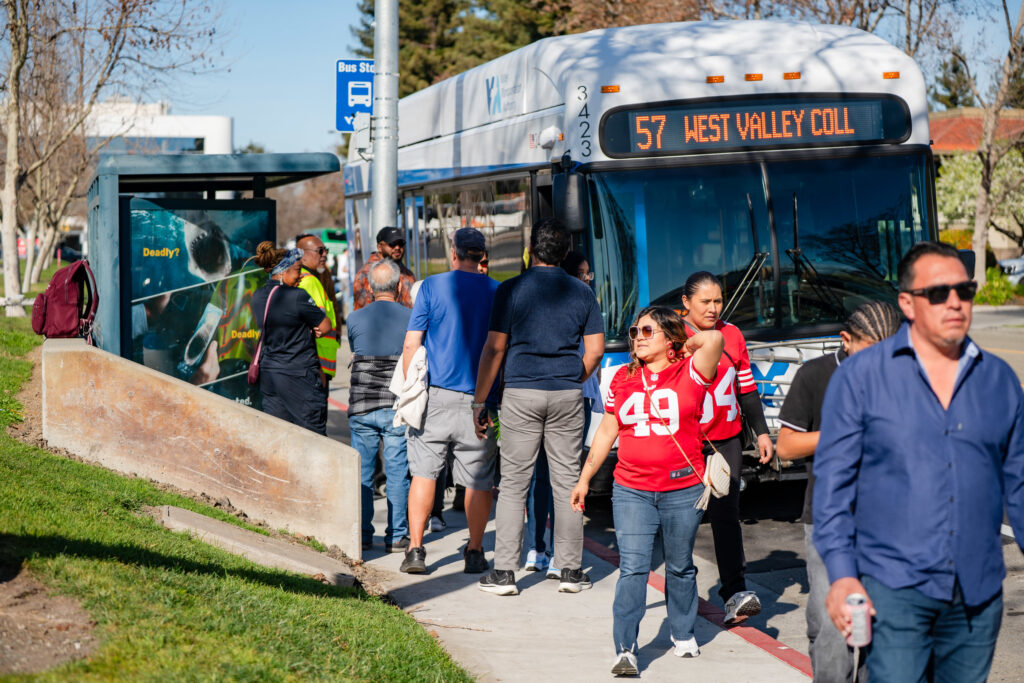
Light rail remained the backbone of operations, but flexibility proved essential. Security perimeters between the Great America and Lick Mill stations required bus bridges to maintain service continuity for both visitors and everyday riders alike. This strategy not only addressed access constraints but also helped distribute crowds more effectively, improving both ingress and egress times.
Service levels were scaled dramatically. VTA operated nearly 300 percent more light rail service and increased bus service by approximately 50 percent compared to a typical Sunday schedule. Staffing expanded across all operational areas, including operators, field supervision, maintenance, security, and the Emergency Operations Center. Additionally, 135 Ambassadors were deployed throughout the system to guide riders and manage crowd flow.
Technology and pre-planning played a key role in smoothing the rider experience. By pairing the Transit app for trip planning with the Token app for fare purchases, VTA created a “Super app” that streamlined how riders interacted with our system on Super Bowl Sunday. Riders took advantage of fare options that included multi-ticket packages, as well as combined one-day passes for both VTA and Caltrain service for easy connections to and from San Francisco. Encouraging advance fare purchases proved highly effective, with 72 percent of riders using mobile ticketing, reducing lines and keeping passengers moving. Super Bowl-branded wayfinding further clarified navigation at stations, platforms, and the stadium itself.
Communications were equally critical. A months-long earned media campaign positioned VTA as the safest and most convenient way to reach the game, generating 185 media placements across more than 65 TV markets. This proactive outreach helped build public confidence and reinforced transit as the preferred travel option.
In total, VTA moved more than 31,000 riders safely and efficiently, demonstrating how preparation, adaptability, and regional collaboration can translate into successful event operations.
Looking ahead, those lessons will inform planning for six upcoming World Cup matches at Levi’s Stadium. Each match will present distinct challenges, from varying crowd dynamics and team traditions to weekday scheduling that must account for peak commuter traffic conditions and driver rest requirements. With a global audience expected, VTA is also enhancing its focus on intuitive, multilingual communication and wayfinding.
If the Super Bowl served as a proving ground, the World Cup will be the next evolution—one where VTA applies its hard-earned lessons to deliver seamless, high-capacity transit on an international stage.