Fifty Years of Advocating for Public Transit—Then and Now
By Anna Lisi, APTA | 4/14/2026
ANNA LISI
Director, Publications and Managing Editor, Passenger Transport
APTA
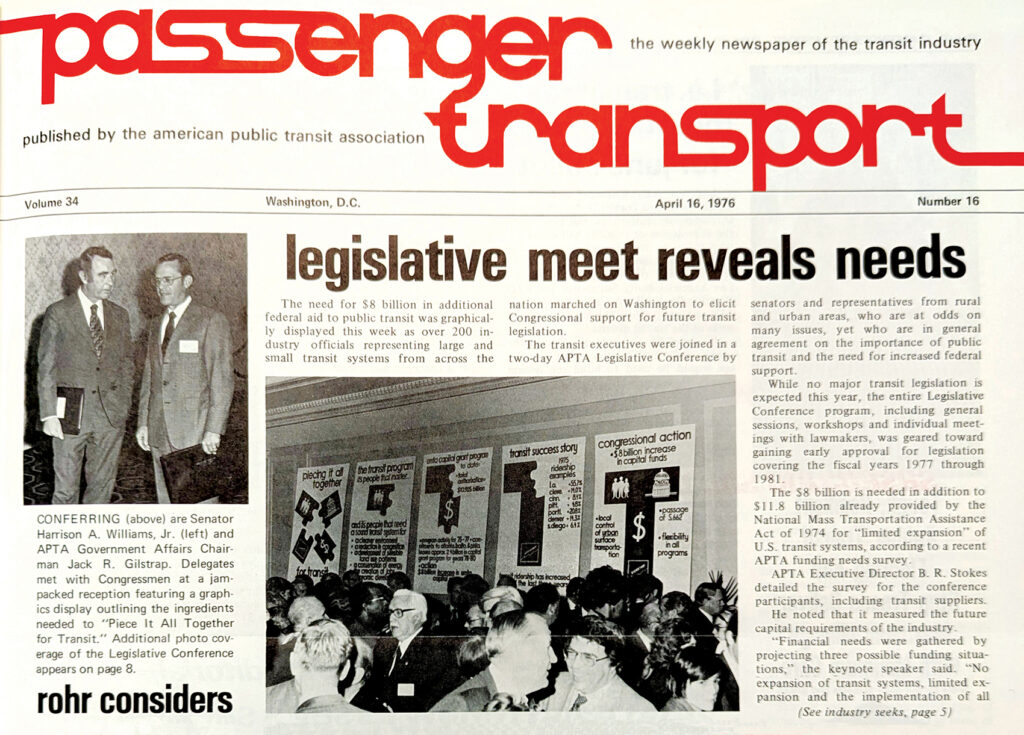
Fifty years ago, APTA held its first Legislative Conference in Washington, DC. The event was covered in the April 16, 1976, issue of Passenger Transport. At the two-day meeting, transit executives joined senators and representatives from rural and urban areas, who were generally in agreement on the importance of public transit and the need for increased federal support. This sentiment is still in place today as research shows that investment in public transportation drives economic growth.
While the times may be changing, APTA’s Legislative Conference continues to gather stakeholders to discuss legislative issues of critical importance to the industry.
Federal Agency
THEN: Urban Mass Transportation Administration, created by the Urban Mass Transportation Act of 1964 to provide federal assistance for mass transit projects.
NOW: Federal Transit Administration, re-named in 1991.
Funding
THEN: APTA members called for $8 billion in federal funding, in addition to $11.8 billion provided by the National Mass Transportation Assistance Act of 1974, for limited expansion of U.S. transit systems.
NOW: APTA is calling for robust federal investment in the next Surface Transportation Authorization bill—$138 billion for public transit and $130 billion for passenger rail over the next five years.
The association is also urging Congress to ensure that no less than 20 percent of new Highway Trust Fund monies is allocated to the Mass Transit Account and at least $21.25 billion in additional transit funding is provided through advance appropriations in a five-year authorization bill.
Viewpoints
THEN: “In this era of urban congestion, environmental concern, social needs, and petroleum shortages we could not in good conscience support a program of no expansion.” – APTA Executive Director B. R. Stokes
“Instead of hearing of public transit that ‘we can’t afford it,’ it should be read that ‘we can’t afford to be without it.’” – Sen. John C. Culver (D-IA)
NOW: “Every federal dollar invested in transit returns five dollars in economic value, with more than 77 percent flowing to the private sector, supporting U.S. manufacturers, contractors, and workers in every state. We look forward to working with Congress to advance sustained federal investment that drives economic growth, job creation, and mobility across the U.S.” – APTA President and CEO Paul P. Skoutelas
“America’s transportation system depends on a funding structure that is fair, reliable, and sustainable. The current system, last adjusted in 1993, no longer reflects how Americans travel today.” – APTA and its partners in a joint letter to preserve the federal user fee system and ensure the solvency of the Highway Trust Fund
Getting Around Washington, DC
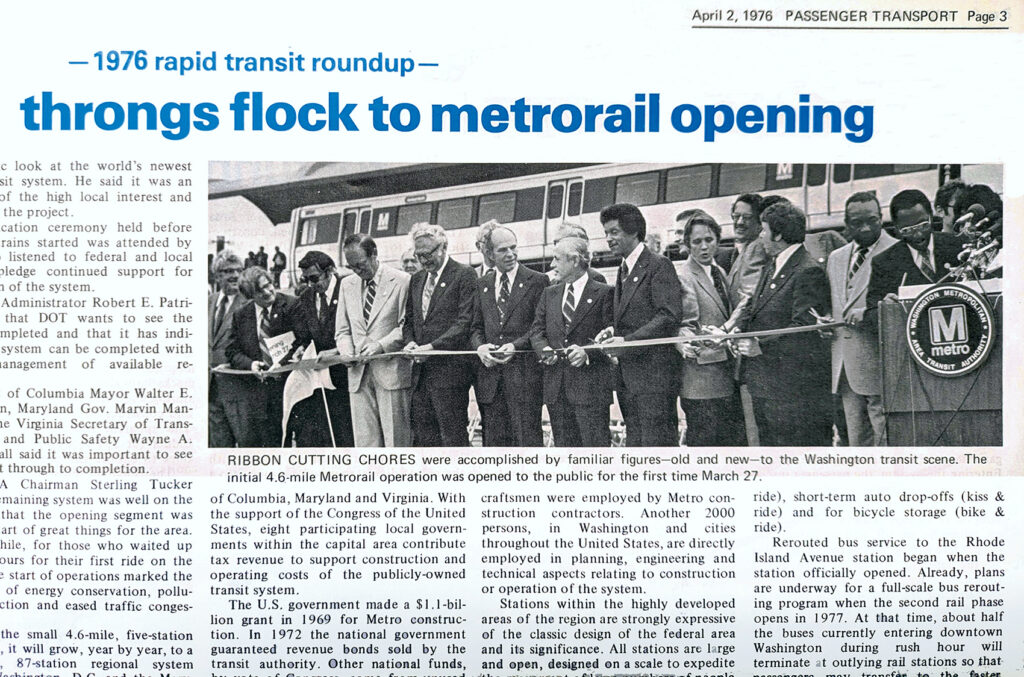
THEN: On March 27, 1976, the first 4.6-mile “Red Line” section of the Washington Metropolitan Area Transit Authority (WMATA/Metro) system opened, featuring five stations. Crowds lined the streets waiting to ride the first trains. My uncle Fred Lisi, who worked at the Department of Veterans Affairs, was among the crowd. He said, “every restaurant was empty at lunch – everyone was riding metro.”
NOW: The second largest heavy rail transit system in the United States, WMATA/Metro operates 98 stations and approximately 130 miles of track over a 1,500-square-mile area, with daily ridership often exceeding 600,000. While we may not forgo our lunch to ride the rails, crowds still amass during rush hour and for special events.
Major Celebrations
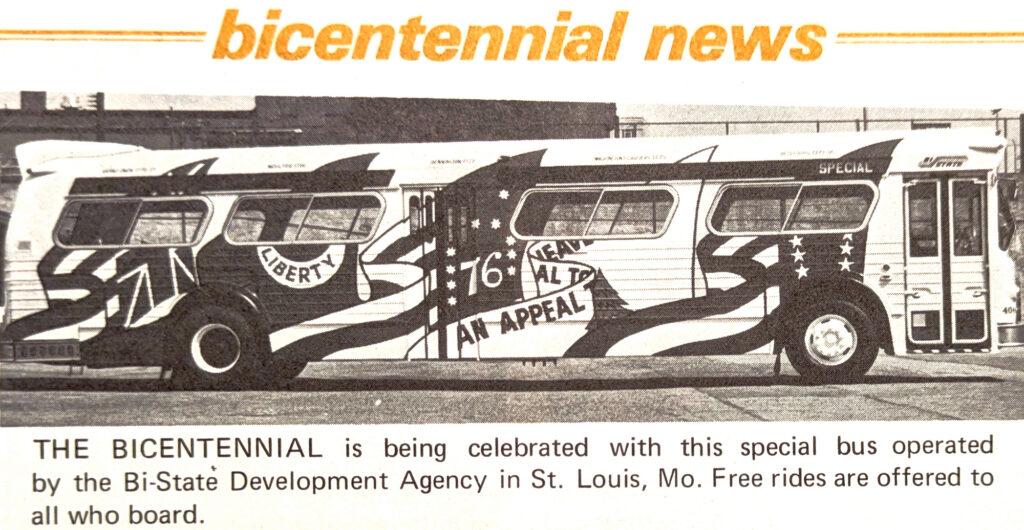
THEN: In celebration of the U.S. Bicentennial, many U.S. transit agencies operated special-themed buses, such as “The Spirit of ‘76” buses.
NOW: Marking the nation’s 250 years, the FTA is rolling out a “Freedom Moves You” campaign to bring iconic American images to airports, highways, train stations, bus stops, and transit networks.