BeST Transit on Its Way to a Propane-Powered Fleet
3/6/2026
BeST Transit, Athens, PA, is going greener. In an effort to save on operating costs, and help save the environment in the process, BeST has begun converting its fleet to operate on propane autogas—one of the fasting-growing alternative fuels in the transit industry.
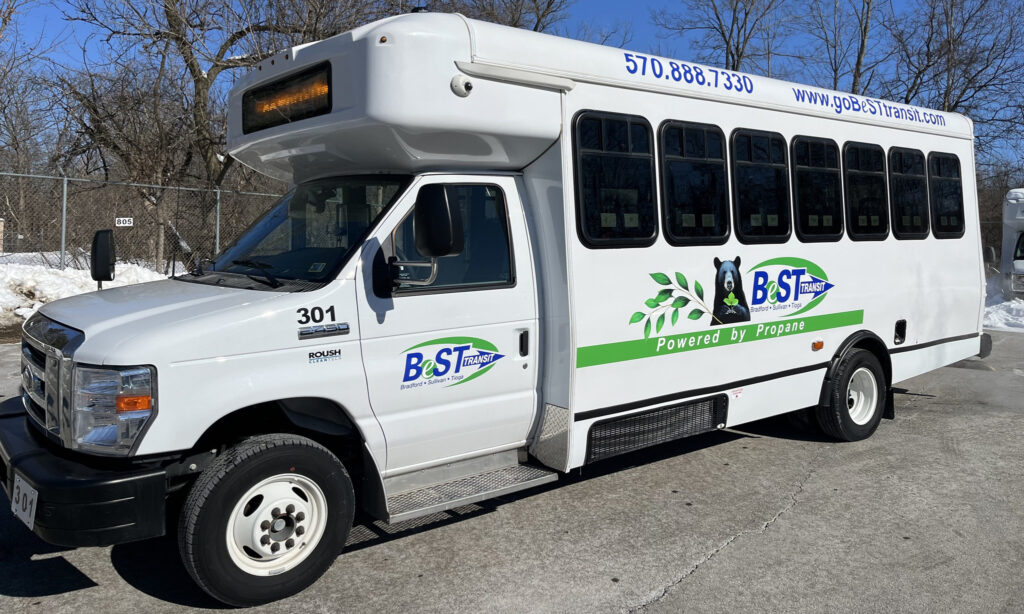
Working closely with ROUSH CleanTech, Ferrellgas, and Coach & Equipment, along with PennDOT, BeST now has six propane-fueled, fixed-route buses in service, moving the authority closer to its goal of having 70 percent of the fleet running on propane in the future.
According to BeST Transit’s executive director Mark Hamilton, phase one of the propane conversion project includes 17 vehicles to equal 25 percent of the fleet: six 2025 Ford E450 buses are already in service, and four more of the same are on the way. Seven 2026 Ford Transit 350HPs are on order and will be used for shared ride programs. They will be dual-fuel propane and gasoline.
The BeST vehicles join more than 7,000 buses equipped with propane fuel systems in operation across North America.
Environmental Outcomes
According to industry experts, propane autogas (also referred to as LPG) is a nontoxic, non-carcinogenic, and non-corrosive fuel, classified as a non-contaminant by the Environmental Protection Agency. Vehicles that run on propane emit fewer greenhouse gases, smog-producing hydrocarbons, and particulate emissions than conventional fuels. In fact, propane engine technology has progressed to the point where harmful emissions are reduced to near zero.
Economical Savings
On average, propane autogas costs about 40 percent less than gasoline. BeST will be able to expect an average savings of $0.25 – $0.45 per mile. Due to the fuel’s clean operation, maintenance service and costs will be significantly reduced as well. Adding to the efficiency, partnering with Ferrellgas, BeST Transit has two on-lot propane fueling stations, one in Athens and one in Mansfield.

Media Event
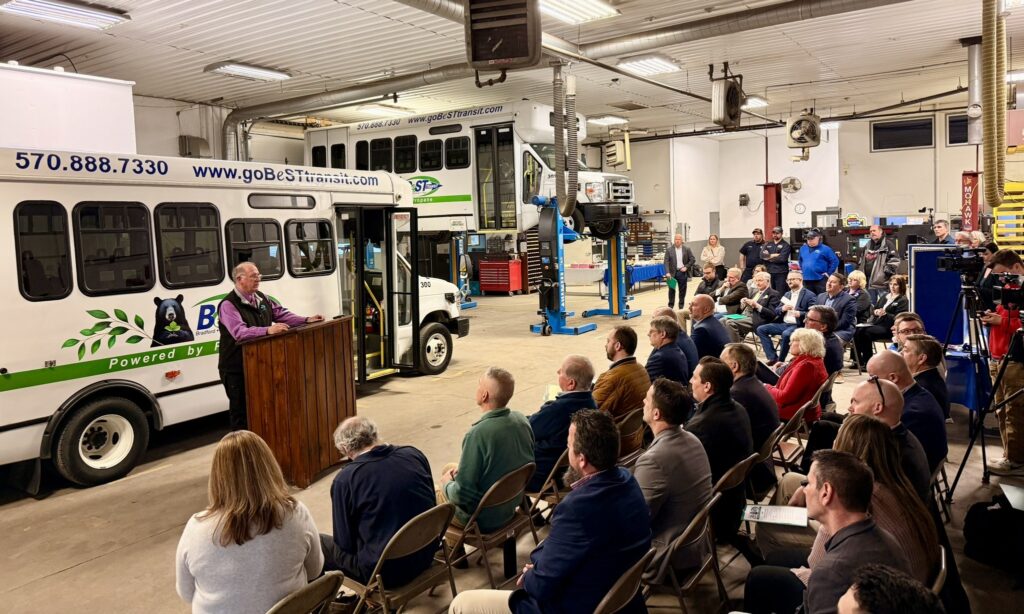
Transit industry leaders and local and state government officials, including PA Secretary of Transportation Michael Carroll, joined BeST Feb. 18 for a ribbon cutting and ceremony.
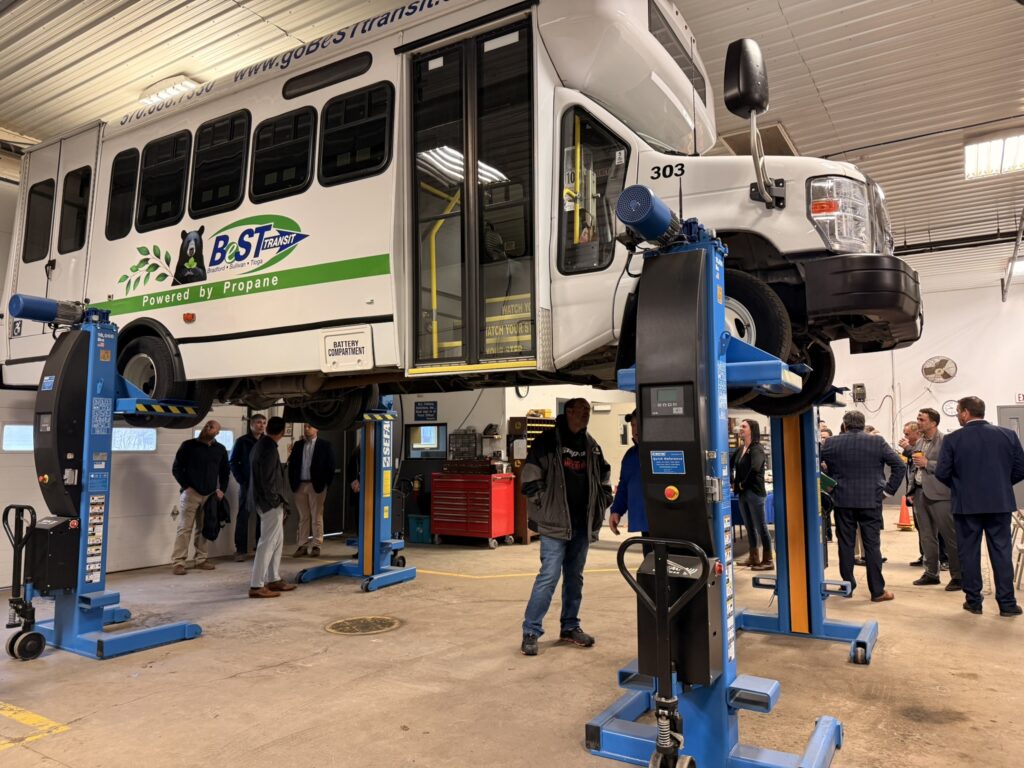
Guests learned about BeST Transit’s journey to propane and had an opportunity to talk to the vendors involved, as well view the brand-new buses, which are complete with updated logos that read “Propane-Powered.” One of the buses was placed on a lift, providing the opportunity to see a close-up view of the ROUSH CleanTech propane fuel system.
Hamilton opened the celebration by introducing the scope of what BeST does and how far its buses travel, including that recently the authority completed an unprecedented 471 trips in one day. He explained how BeST’s first step was an agreement with the Department of Environmental Protection for $300,000 to convert 10 buses to propane. From there, he said, his staff and each partner played integral roles in bringing the project to fruition.
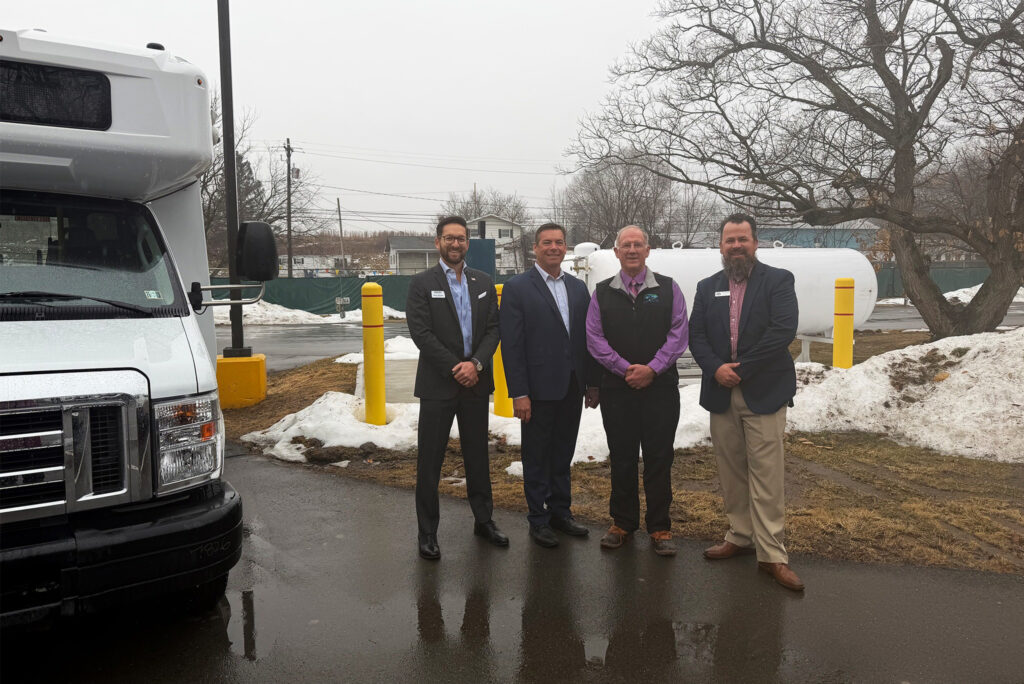
Carroll addressed the audience, praising Hamilton at the helm, the board of directors, and all the staff that work together to keep BeST Transit operating successfully. He said, “We’re here today to celebrate PennDOT’s investment of over $870,000 in these vehicles. And, an additional $200,000 dual-fuel transit commitment, bringing our commitment to this region to over $1 million.” He added that Pennsylvania’s transit systems are a lifeline for many people across the state, saying 57 percent in this region (Bradford, Sullivan, and Tioga counties) say they have no other alternative.
Representing ROUSH CleanTech, executive director of transit Randy Veenhoven, fittingly compared its partnership with BeST to the Olympics, stating, “It takes an effort on everybody’s part. When we see someone on the podium, for whatever country they are, we’re excited and we’re happy for them. Because it takes a partnership, a staff, members that were involved in that person’s success, and we all rejoice in that success. To be here with BeST is my Olympic dream come true,” adding he’s very confident in the partnership, and that “we have reached a gold level standard for this community.”
Moving on to fueling the vehicles, Brian Raygor from Ferrellgas agreed with Veenhoven, noting the key word is partnership. He said Ferrellgas is very happy to be one of the partners “in the initiative to use propane, a low-carbon, alternative energy, that is produced domestically and has 90 percent less-toxic emissions than diesel.”
“For the first time ever, BeST Transit will now connect people, jobs, and communities throughout the Endless Mountains with clean, reliable transit vehicles powered by propane autogas,” said Todd Mouw, executive vice president at ROUSH CleanTech. “BeST’s newest propane vehicles are so reliable they were driven from our factory in Michigan to Pennsylvania without a single issue—a testament to their durability and economical value. We’re proud of the partnership forged between BeST and ROUSH CleanTech to launch this initiative, and we look forward to seeing residents in Bradford, Sullivan, and Tioga counties thrive thanks to these advanced propane vehicles.”