APTA Comments on Proposed Rule Restricting Unmanned Aircraft Near a Fixed-Site Facility
8/19/2026
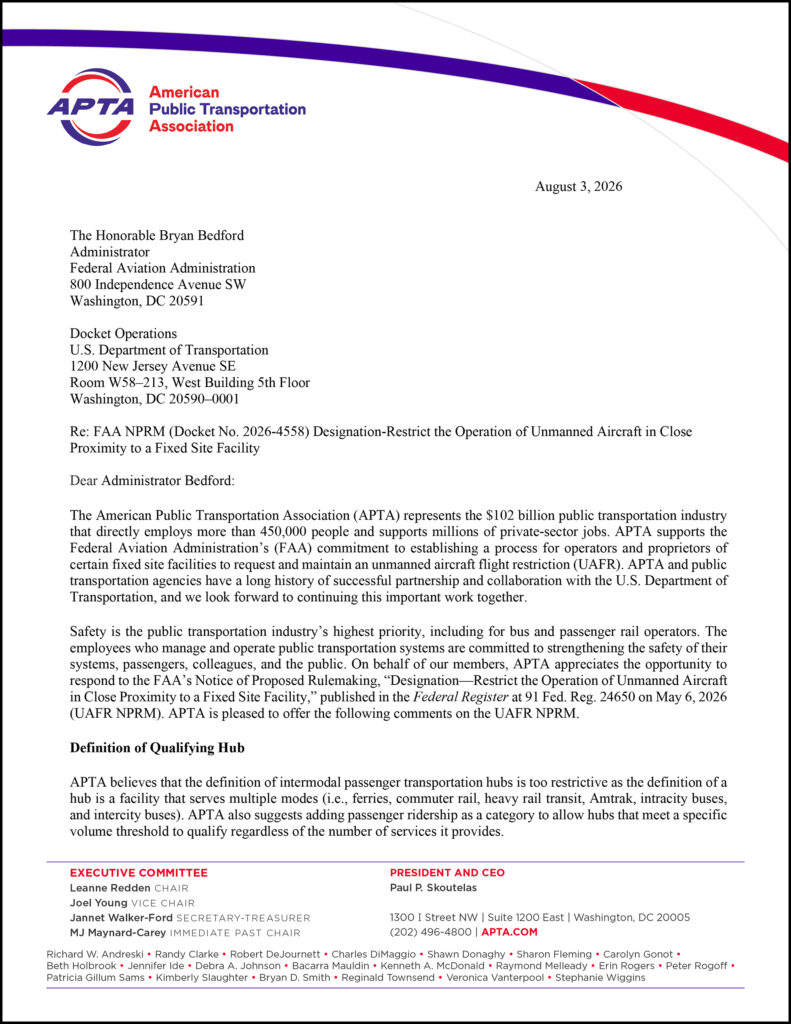
On August 3, APTA responded to the FAA’s Notice of Proposed Rulemaking, “Designation—Restrict the Operation of Unmanned Aircraft in Close Proximity to a Fixed-Site Facility,” published in the Federal Register (91 Fed. Reg. 24650). APTA’s comments focused on the definition of a qualifying hub; considerations for special events, accidents, and incidents; and expanded criteria.
In its comments, APTA said it “supports the expansion of the certification requirements and criteria applicable to the mass transit and passenger rail subsector for restricting the operation of unmanned aircraft. Public transportation owners and operators should have the ability to apply for a UAFR [unmanned aircraft flight restriction] based on credible safety or security threats or conditions.
“APTA encourages the FAA to provide a practical process for requesting both permanent and temporary UAFRs, reflect on the unique safety and security concerns and threats associated with the mass transit and passenger rail subsector, and permit reasonable restrictions established by risk assessments, available intelligence, operational requirements, and facility footprint.”
Specifically, APTA:
- Believes that the definition of intermodal passenger transportation hubs is too restrictive.
- Suggested adding passenger ridership as a category to allow hubs that meet a specific volume threshold to qualify regardless of the number of services it provides.
- Encouraged FAA to consider restricting the operation of unmanned aircraft during special events with high transit usage, accidents, and incidents, citingmega-events such as the World Cup and upcoming Olympics in Los Angeles.
- Recommended that FAA consider revising the criteria allowing transportation operators to apply for a UAFR, noting that there may be conditions where expanding airspace restrictions beyond physical property boundaries is critical to mitigating risks to a facility and protecting critical rail infrastructure.