APTA President Discusses Safe, Scalable Deployment of AVs at Carnegie Mellon Safety21
11/16/2026


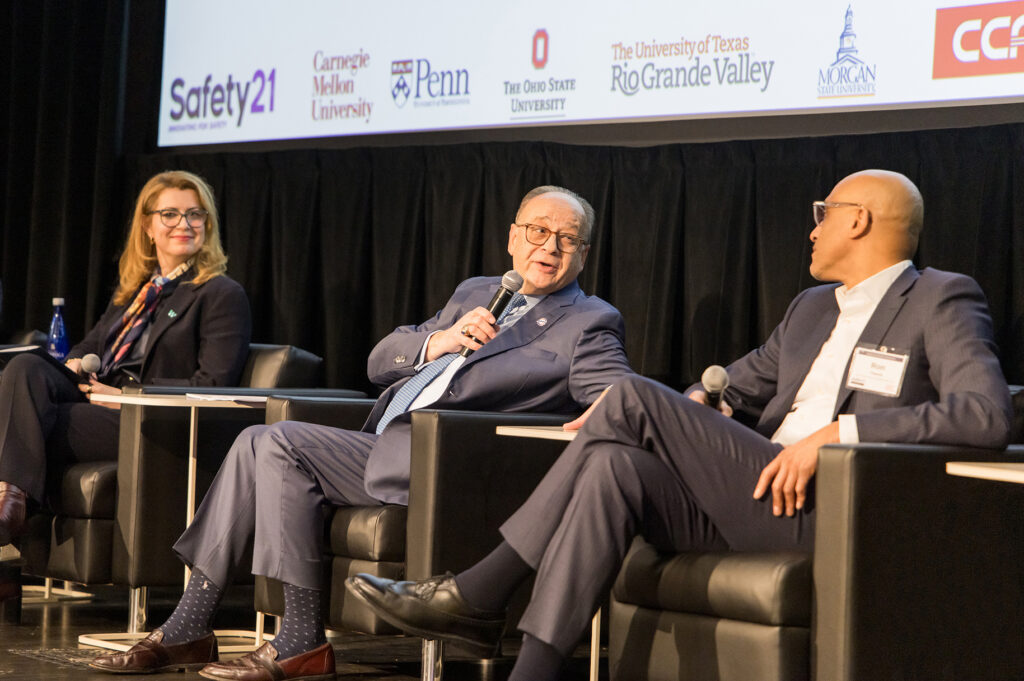
APTA President and CEO Paul P. Skoutelas joined transportation industry, government, and research leaders November 12 for a panel discussion on the safe deployment of autonomous vehicles (AVs) at the 2026 Safety21 Deployment Partner Consortium Symposium, Scaling Safe Transportation: Advancing Safety, Digital Infrastructure, and Innovation for Real-World Impact.
The panel, Deploying Automated Transportation Safely at Scale, examined the infrastructure, technology, policies, and operational strategies needed to move AVs from pilot programs to widespread real-world use. Discussion also addressed the partnerships among industry, government, labor, and DOTs needed to ensure that automated transportation systems operate safely and effectively for all road users.
Skoutelas emphasized that the successful integration of AVs into public transportation will require more than advances in vehicle technology. Transit agencies must consider how these services can deliver measurable benefits, including improved safety, stronger first- and last-mile connections, and expanded mobility options, while earning public confidence and support.
He noted that public transportation’s reliance on local, state, and federal funding, as well as customer fares, makes public trust essential. Safety, reliability, accessibility, and affordability remain the foundations of that trust, and emerging technologies must demonstrate their value against those expectations.
Drawing on his engineering background, Skoutelas acknowledged the rapid technical progress being made by AV developers but underscored the challenge of transitioning from experimentation to permanent service that the public will embrace. That transition, he said, requires a coordinated approach encompassing infrastructure, technology, operations, communications, workforce training, and governance.
APTA is helping advance that effort through two member-driven autonomous vehicle committees, one focused on technical issues and the other on policy and innovation. The committees provide a forum for transit agencies and industry partners to share information and develop approaches to implementation, funding, legislation, and regulation.
Skoutelas also pointed to growing activity across the public transportation industry, with autonomous buses, trains, and shuttles being tested or deployed by agencies in communities including Las Vegas, Houston, Denver, and Phoenix. He noted that transit agencies are also beginning to incorporate artificial intelligence and machine learning into functions such as maintenance and route planning.
As automated transportation moves toward broader deployment, Skoutelas stressed the importance of collaboration among transit agencies, technology developers, government partners, and the workforce. Investments in digital and physical infrastructure must be accompanied by investments in frontline employees and transit leaders, as well as education and advocacy.
The symposium was organized by Safety21, a USDOT-sponsored National University Transportation Center led by Carnegie Mellon University in Pittsburgh, PA. Its Deployment Partner Consortium connects transportation stakeholders with researchers to identify real-world needs, develop and deploy research projects, support technology commercialization, and create opportunities for student recruitment, internships, and applied academic projects.