APTA Webinar Highlights Approaches and Tools to Advance TOD
10/28/2026
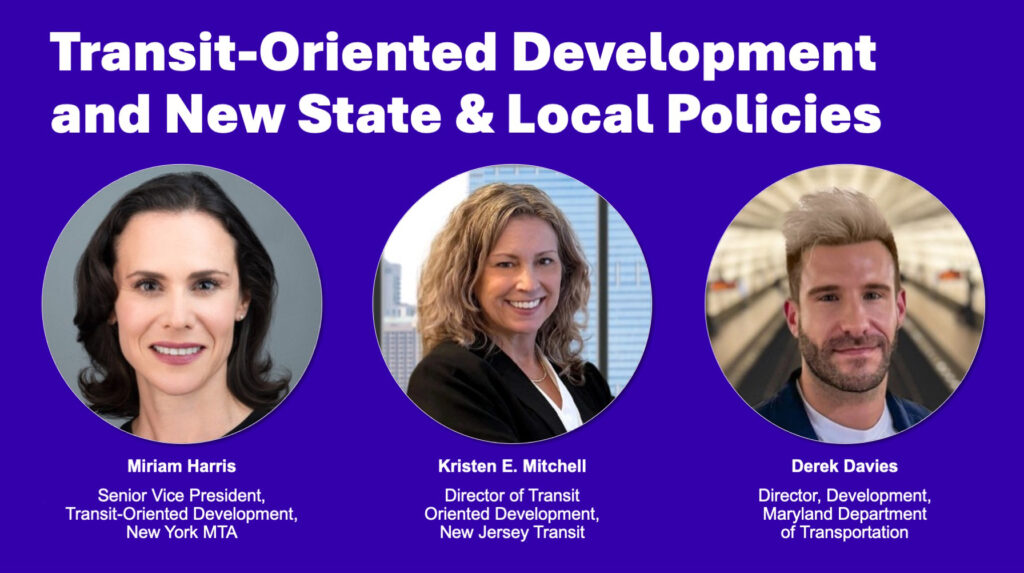
A recent APTA webinar explored how new state executive orders and laws are helping three public transit agencies to support housing, improve accessibility, and generate broader community benefits through transit-oriented development (TOD). Representatives from New York Metropolitan Transportation Authority (NYMTA), NJ TRANSIT, and Maryland DOT shared their agencies’ approaches and projects, which vary based on local market conditions, agency authority, available land, and policy priorities.
The panel featured Miriam Harris, senior vice president of transit-oriented development at NYMTA; Kristen E. Mitchell, director of transit-oriented development at NJ TRANSIT; and Derek Davies, director of development at MDOT. Sasha Page of RebelGroup and Dennis Wood of Greystone Real Estate Advisory Group—co-chairs of APTA’s Real Estate Subcommittee—moderated the discussion.
“As transit agencies face growing financial pressures, APTA’s Real Estate Subcommittee plays an increasingly important role in bringing public and private sector professionals together to identify innovative ways to maximize non-farebox revenues, share expertise, and exchange best practices,” said Wood.
Agency Approaches
At NYMTA, Harris described how the agency uses TOD to pair development with accessibility improvements and other capital needs. She discussed the agency’s Zoning for Accessibility program, infrastructure challenges, directing revenue to its capital plan, and TOD opportunities connected with major expansion projects.
At NJ TRANSIT, TOD must work across urban, suburban, and rural settings. Mitchell highlighted the agency’s LAND Plan, the importance of flexibility to respond to market needs, and the opportunities that can arise from unsolicited development proposals.
In Maryland, Davies framed TOD as a statewide tool for addressing housing supply, job growth, and economic development. The state has substantial inventory of land near transit, and recent policy changes related to zoning have removed some development barriers. He also discussed the need for financing tools to help projects move forward in a challenging market.
“New state initiatives are helping to raise TOD to a new level in these states, part of a national trend to strengthen TOD-supportive public policies at the state and local level,” explained Sasha Page.
Panelists answered questions related to maximizing value while meeting objectives related to affordable housing, accessibility, infrastructure improvements, and climate resilience. They also discussed TOD opportunities around bus depots, city–agency zoning issues, and the ability to obtain public funding.
Listen to the webinar to hear the panelists’ case studies and discussion of the policy and financing tools shaping TOD in New York, New Jersey, and Maryland.