Sen. Cantwell’s “Chopping Block” Reports Detail Impacts of Cuts to Federal Transportation Infrastructure Programs
10/27/2026
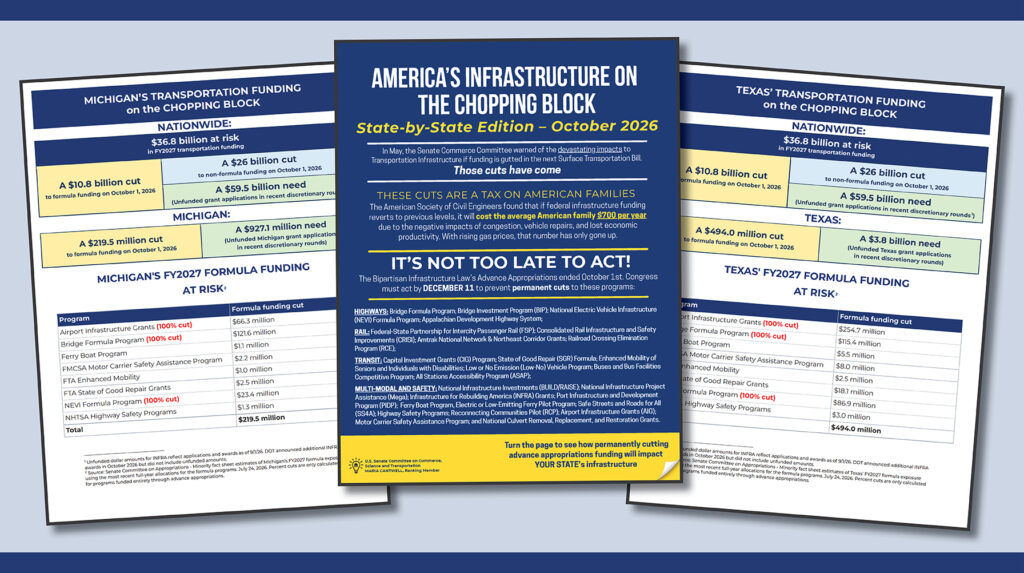
The future of critical transportation infrastructure investments is at stake as Congress considers whether to renew billions of dollars in federal funding established under the Infrastructure Investment and Jobs Act (IIJA). The consequences could reach passenger rail systems, local communities, and economic development projects across the United States.
In updated state-by-state “Chopping Block” reports released Oct. 27, Sen. Maria Cantwell (D-WA), ranking member of the Senate Committee on Commerce, Science, and Transportation, details the potential effects of allowing the law’s multiyear transportation funding commitments to lapse. The reports warn that failure to renew $36.8 billion in fiscal year 2027 advance appropriations could leave thousands of infrastructure projects without funding.
Enacted in 2021, the IIJA established five years of guaranteed funding for federal transportation programs and supported more than 140,000 infrastructure projects nationwide. The law’s advance appropriations expired October 1, 2026, without renewal, although Congress extended surface transportation programs through a continuing appropriations measure.
According to Cantwell, the expiration immediately reduced federal transportation funding to states by more than 30 percent. Without congressional action, communities could lose planned investments in passenger rail, bridges, safer streets, and other infrastructure essential to mobility and economic vitality.
Passenger rail faces significant uncertainty.
The IIJA provided $66 billion over five years to improve passenger rail service, strengthen supply chains, and enhance rail safety. Cantwell’s report estimates that funding for four essential rail programs could decline by 83 percent if the advance appropriations are not renewed.
The stakes are substantial. Amtrak carried a record 34.5 million passengers in 2025 and serves 40 percent of the nation’s small and rural communities. Nearly one in five Amtrak passengers travels to or from a station without access to air service. Sustained investment is therefore important not only to major metropolitan areas, but also to smaller communities that depend on rail for connectivity and access to opportunity.
The funding uncertainty also raises questions about the future of local infrastructure and economic development. The IIJA established grant programs that enable local governments to seek federal support directly for community improvements. This is particularly important because, according to the report, only 16 percent of federal highway formula funding reaches local roads.
Without renewal, funding for three grant programs supporting local economic development could decline by 90 percent. Such reductions could jeopardize projects that improve downtown districts, strengthen connections between transportation and community destinations, and support local businesses.
The reports also highlight potential reductions in freight infrastructure funding, underscoring the broader economic consequences of abandoning a multiyear investment strategy. However, the immediate concern for passenger transportation is the ability to sustain improvements that expand mobility, strengthen regional connections, and serve communities of different sizes.
Congressional action will shape the next chapter of transportation investment. The IIJA demonstrated the value of providing transportation programs with a multiyear funding framework. Preserving that predictability is essential for agencies and communities making long-term decisions about infrastructure, service, and economic development.
As Congress considers the next steps, the challenge is to ensure that transportation investments already underway—and the projects communities still need—are not lost to funding uncertainty. Continued federal commitment will be critical to maintaining progress toward a safer, more connected, and more reliable transportation network.
How You Can Help
APTA has launched an email advocacy campaign for public transportation allies to contact representatives and senators to restore public transit and passenger rail funding to FY 2026 enacted levels. Join the email advocacy campaign here.
In addition to the email campaign, APTA encourages its members to host Members of Congress to see first-hand how public transportation investment works for everyone. APTA’s Site Visit Toolkit provides guidance.
Additional APTA advocacy tools include:
- Transportation Appropriations and Extension Talking Points
- Smart Guide to Surface Transportation Authorization
- Industry Footprint
- My Economic Impact
Learn more at the APTA Advocacy Resource Center.
Also, APTA’s Winter Legislative Meeting and Capitol Hill Holiday Reception will take place December 3 in Washington, DC. Learn about APTA’s advocacy priorities and how you can support them.