Mayors Frame Transit Investment as a Choice for Cities’ Future
10/9/2026
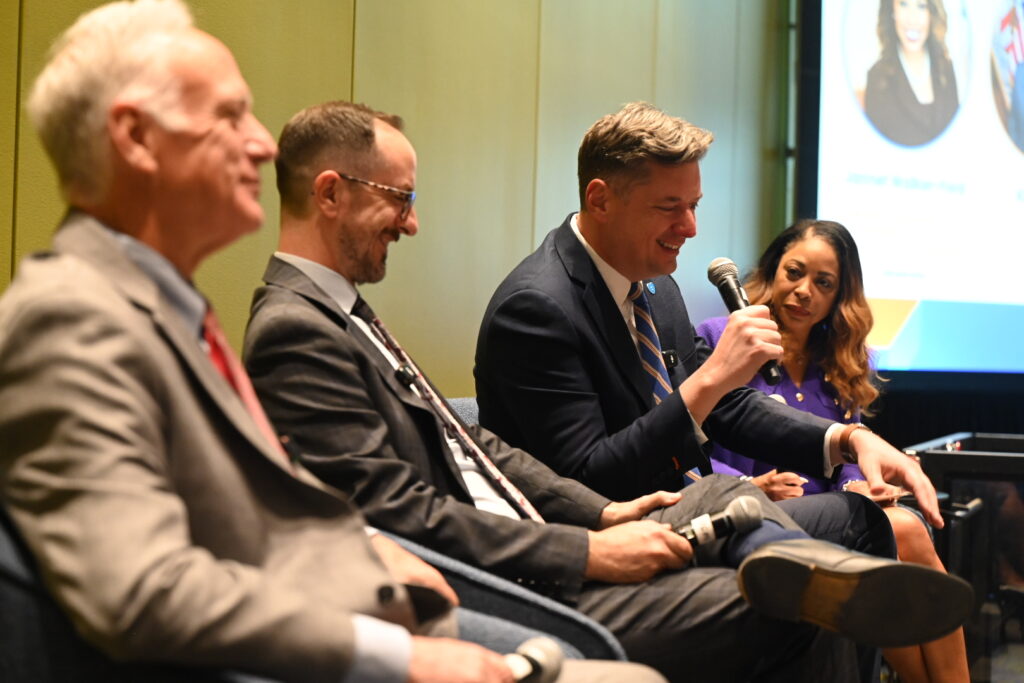
Transit ballot measures are shaping how three fast-growing southern cities that were built around the automobile envision their futures. At APTA’s 2026 TRANSform & EXPO in Chicago, IL, Austin Mayor Kirk Watson, Nashville Mayor Freddie O’Connell, and Oklahoma City Mayor David Holt described those measures as giving residents more choices, greater access to opportunity, and relief from the rising costs and congestion that accompany growth.
The panel, A Candid Conversation with Mayors: The Future of Cities and theFuture of Transit, was moderated by Jannet Walker-Ford, APTA secretary/treasurer and WSP business line executive for advisory and planning. The panel was sponsored by Stantec.
Ballot Measures Move Visions Toward Reality
In 2000, Austin voters narrowly rejected a light-rail proposal. Two decades later, they approved Project Connect, which combines rail with stronger bus service, pedestrian improvements, and complementary land-use changes.
“The best time in the history of Austin to begin a rail project was in 2000,” Watson said. “The second-best time is what we’re doing right now.” Waiting makes infrastructure more expensive and leaves cities less prepared for population growth.
Nashville’s path also followed an earlier defeat. A 2018 transportation referendum failed by roughly two to one. The measure that passed in 2024 was organized around four easy to understand principles: sidewalks, signals, service, and safety.
Since approval, Nashville has expanded transit service four times, advanced more than 70 sidewalk projects, begun upgrades at more than 200 signalized intersections, and created a transit security partnership between the transit authority and police department. The program is also moving Nashville toward transit service around the clock, every day of the year.
Oklahoma City, meanwhile, is preparing for a 2027 initiative. The city has already built a downtown streetcar, opened its first BRT line thanks to a federal grant, and secured two more BRT lines through a 2019 initiative. However, it needs a larger, sustained financial commitment to meet expected growth.
“We really are Nashville and Austin 20 years ago,” Holt said. Oklahoma City added approximately 250,000 residents within city limits over the past three decades and expects roughly that many more over the next quarter-century. “We would never run transit initiatives in cities like these other than for the most pragmatic reasons. We do these things because our residents absolutely see a need,” Holt said.
Choice, Opportunity, and Household Savings
Austin Mayor Watson said a stronger transit network can help residents reach jobs and education, support walkable communities, and make housing more affordable. A household that can forgo a car could save an estimated $12,000 to $13,000 a year—money that can determine whether someone can remain within the city.
Mayor O’Connell connected the issue to his own years of living car-free in Nashville. Avoiding the expense of a car helped him become a homeowner earlier, while walking, biking, and using transit gave him a street-level view of gaps in sidewalks, shelters, and safe connections.
“Frequency is freedom,” he said. That principle is visible in Nashville’s airport service, where more frequent conventional bus service—designed largely for the airport workforce—has produced a sharp increase in ridership. O’Connell said residents have told him that cutting waits from 30 to 15 minutes transformed the bus from an unreliable option into one they could count on.
In Oklahoma City, residents may not need transit today, Mayor Holt said, but a commute that has already grown from 15 to 20 minutes could become 50 minutes as the region expands. Because major transit projects take years to plan and build, cities must act before congestion makes the need unavoidable.
Transit as a Platform for Growth
Transit infrastructure does more than move people; it influences housing, workforce development, and economic activity.
Holt cited hundreds of millions of dollars in development along Oklahoma City’s downtown streetcar route and said future stations could attract needed density. Watson pointed to Austin’s Infrastructure Academy, which is preparing the future workforce. Austin is also pursuing a rail connection to its airport, which would benefit travelers, workers, downtown businesses, and the convention economy.
As the cities grow, they are increasingly moving more people as they host major events. Oklahoma City will host canoe slalom events and the softball tournament during the 2028 Los Angeles Olympic Games. The city anticipates 16 consecutive days of competition and will need creative short-term transportation measures alongside its longer-term transit plans. Meanwhile, Nashville is preparing for a new NFL stadium, slated to host the Super Bowl in 2030.
Invest Now—and Build Trust
The mayors acknowledged that long-range ambition must be matched by near-term accountability. Watson said leaders cannot lose sight of the fact that today’s residents are being asked to pay for projects whose full benefits emerge decades later. Holt said it’s about “building the city for your kids and your grandkids.”
Careful design, cost control, and risk reduction are essential to stewarding public money and maintaining trust as these southern cities consider their futures. New generations are asking for walkable, connected places, and residents are returning to urban cores. As cities grow, the cost of inaction also grows.
Read more about Austin Mayor Kirk Watson’s work with Austin Transit Partnership.