Expertorial: Masabi—COTA Tap to Pay
10/7/2026
Delivering Open Payments Without Compromising Rider Benefits
SPECIAL ADVERTISING SECTION
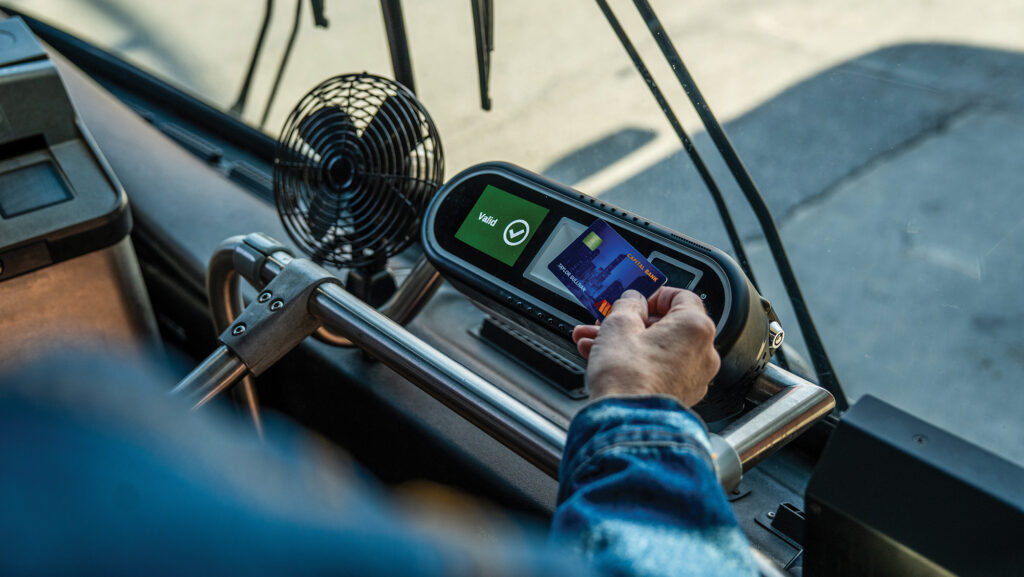

In many transit systems that have added Open Payments using contactless bank cards, the easiest way to pay can also be the most expensive. Too often, introducing contactless payments creates a trade-off. Fare capping, free transfers, reduced fares and concessions, and access to payment history may remain available to smartcard or app users, but not to riders who use Open Payments.
How a rider pays should not decide what they pay and, for transit agencies, accepting a contactless card is the straightforward part; applying the right fare is not. One agency’s approach was to add Open Payments without creating a second-class fare experience.
The COTA Example
The Central Ohio Transit Authority (COTA) focused on rider benefits when it launched Tap to Pay across its network in January 2026. Open Payments was added as an additional payment method on top of the agency’s existing account-based fare system, which had been introduced in partnership with Masabi in 2021. Instead of redesigning fare policy around a new payment channel, COTA was instead able to extend the same policy and rider protections to contactless payments.
A rider tapping a credit card, debit card or mobile wallet receives the same fare capping available through other digital payment methods. In the case of COTA, this is no more than $4.50 per day or $62 per calendar month when using the same payment method, and two-hour fare-free transfers are applied automatically. Riders enrolled in COTA’s Reduced Fare Program can link eligible payment methods to their account through the Customer Experience Center meaning the appropriate discounted fare applies when they tap. Riders who link their card can also review their payment history. In other words, the payment method changed, but the promise to the rider did not.
That distinction is important as fare policy forms a key part of the customer experience, not a back-office detail. An equitable fare experience means that riders can access the same caps, discounts and entitlements regardless of the type of ticket they use. Riders should not have to choose between convenience and the best available fare.
The same approach also simplifies operations for COTA staff. Because fare and Open Payments data is captured in real time within Masabi’s Justride platform, the agency’s teams have a single back office for reporting, analysis and reconciliation rather than piecing together data from separate systems.
Just as importantly, COTA did not make modernization synonymous with replacement. COTA Smartcards, ULTRA Light Card passes and tickets in the Transit app remain available alongside contactless payments. This means that riders can choose the payment method that works best for their circumstances while the underlying fare rules remain consistent.
COTA’s Fixed-Route Customer Satisfaction Survey found that 93% of customers already have a credit, debit or other payment card. This meant that, for many riders, contactless payments remove a step, with there being no ticket to buy, app to download or stored value to preload.
“Tap to Pay reflects COTA’s continued commitment to applying technology to improve the customer experience while modernizing how our system operates,” said Sophia Mohr, Chief Innovation and Technology Officer at COTA. “Our team has worked to integrate this technology so customers can board quickly, receive the best possible fare through fare capping, and travel with confidence using the payment tools they already carry with them every day.”
COTA’s experience is also relevant because its scale serves as an important comparable to much of the U.S. transit industry. Serving approximately 12 million riders annually across fixed-route, on-demand and paratransit services, COTA shows that an advanced, equitable fare experience need not be the preserve of only the country’s largest systems.
For agencies considering their own path to Open Payments, the lesson to take from COTA is less about a particular payment technology than about the order of operations. Defining the fare policy riders should receive and then adding payment choices without creating different classes of rider experience.
The goal should not simply be to make tapping possible. It should be to make tapping feel like just another doorway into the same fair, familiar fare system. COTA’s approach offers a practical model showing that Open Payments can add convenience without asking riders to give anything up.
Lindsay Richardson
Head of Customer Experience at Masabi