Transit Transformed: The Bay Area’s New Age of Innovation
By Shalonda Baldwin | 4/9/2026
SVP and California Regional Business Leader for Transportation Infrastructure
WSP

With Super Bowl LX in the rearview and a convergence of major events on the horizon—from NCAA March Madness to World Cup matches at Levi’s Stadium—transit agencies are being tested on their ability to deliver exceptional performance when the stakes are highest.
Those demands have been particularly visible in the San Francisco Bay Area, so it is good news that the region has punched above its weight on public transit since the debut of horse-drawn omnibuses in 1851. In recent years, the region has become a testbed for forward-looking ideas that can shape the region’s future—and serve as a model for others.
Regional authorities are finding new ways to improve speed, reliability, and safety and integrate greater convenience through digital technologies. For agencies and cities trying to modernize systems and rebuild ridership, San Francisco’s evolving playbook is worth a closer look. Here are five insights to consider:
- Control is the future: The Train Control Upgrade Project (TCUP) puts the San Francisco Municipal Transportation Agency (SFMTA) on track to be the first U.S. transit agency to modernize its train control system. A critical, once-in-a-generation investment, it will provide the tools to deliver more reliable, faster, higher-frequency, higher-capacity and safer Muni Metro service throughout San Francisco. This modern Communications-Based Train Control (CBTC) technology will reduce travel and wait times, expand Muni Metro’s capacity by up to 20 percent, and realize new operational efficiencies with fewer system failures.
TCUP is designed to involve seven phases. The first will install the CBTC system on the street for the first time, serving high-traffic destinations. The second phase will deploy the new CBTC in the subway. Phases three through seven involve staged expansion to new on-street branches. Effective planning means significantly modernizing the system over time, managing the timing of expenditures and allowing the system to learn and adapt to change.
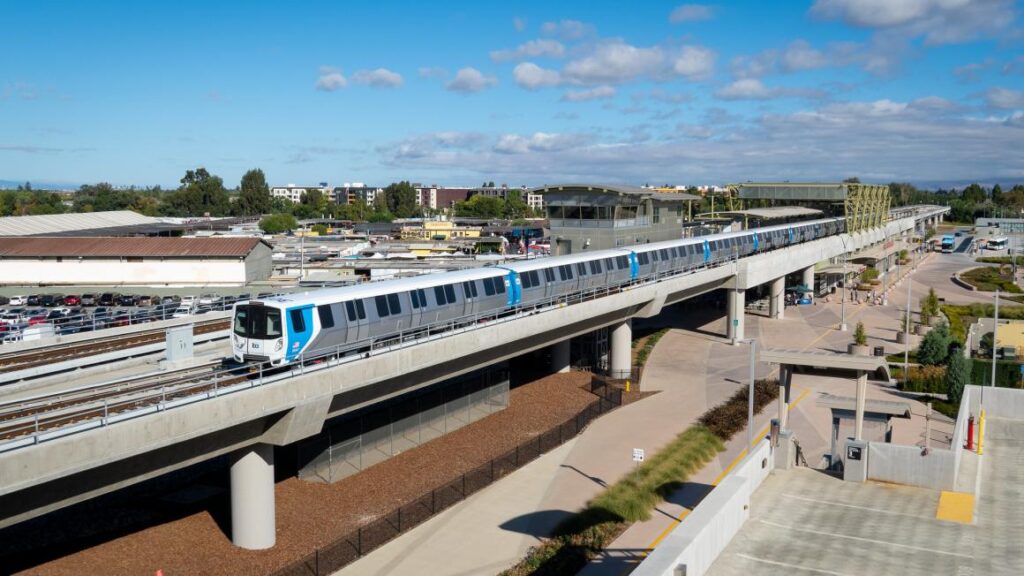
- Make the customer the core: Bay Area transit agencies are working to put the customer experience at the center of the system. For example, SFMTA, the Santa Clara Valley Transportation Authority (VTA), and Bay Area Rapid Transit (BART) are investing in the details that shape how riders actually feel on the network.
Customer experience programs involve mapping the complete customer journey, examining what riders see, hear, feel, and experience at every touchpoint. On the street, SFMTA has focused on making service faster, more reliable, and easier to navigate. Efforts include red transit-priority lanes, refreshed stop spacing, and redesigned locations. Inside stations, improvements like brighter lighting, clearer wayfinding, cleaner platforms, and visible safety ambassadors help riders feel secure while they wait. On board, modernized trains and buses, clearer audio announcements, and improved air quality enhance comfort during the journey. Behind the scenes, upgraded control systems improve reliability, while real-time information systems keep riders informed when delays occur.
For these changes to take hold, agencies must identify desired outcomes from the outset and build in metrics to track progress. Public transit works best when it works for everyone, starting with the customer. This type of customer-centricity can rebuild ridership and future-proof customer engagement during times of financial constraint.
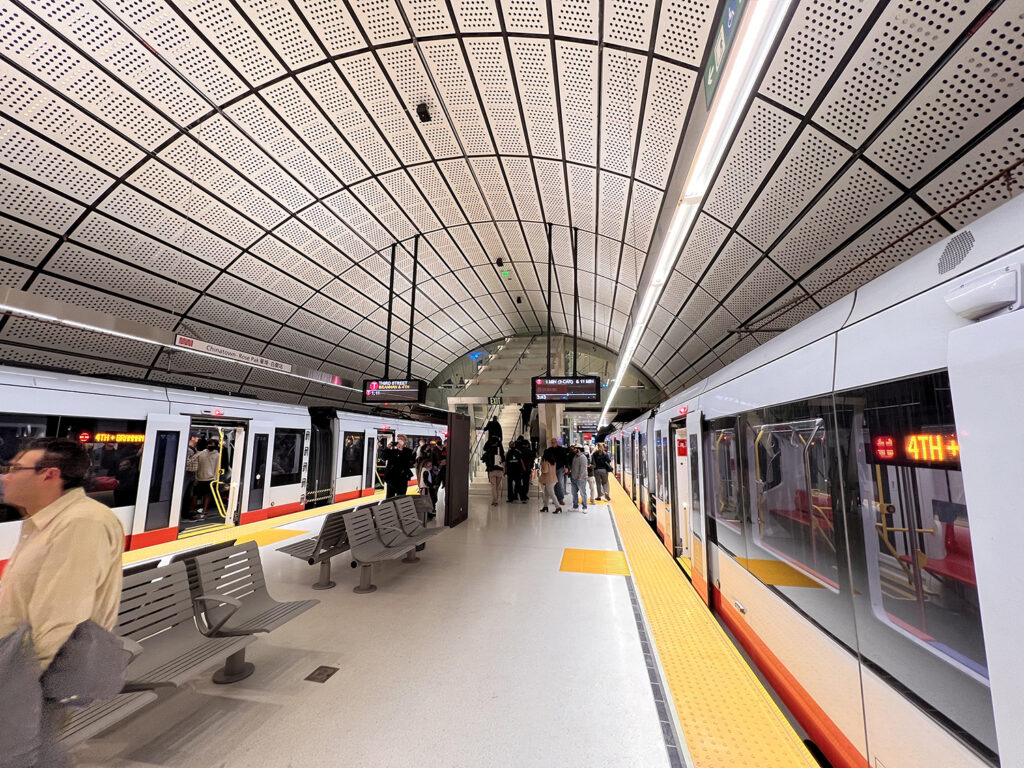
- Access requires design: San Francisco’s 1.7-mile Central Subway extension is a case study in accessibility. It serves Chinatown, a dense, highly transit-reliant neighborhood that faced long travel times and limited options for one-seat rides. Opened in 2022, Central Subway is not only benefiting community residents but transforming north-south public transportation by providing better service to BART, Caltrain, and major sports venues.
While it required complex engineering and tunneling under urban streets in a seismic zone, the bigger challenge was the vision and commitment required to reduce disparities in access. It exemplifies the benefits of looking beyond traditional metrics and considering not just whether an area is transit-rich, but whether its residents are transit-dependent and well-served.
- Electrification drives multiple benefits: San Francisco’s network of 300 trolleybuses has been moving people on zero-tailpipe-emission vehicles for generations. Now SFMTA is going further, with a goal of full fleet electrification by 2035, which can cut costs and improve public health by reducing air pollution. A multi-year battery-electric bus pilot is supported by nine new depot chargers, part of a zero-emission bus rollout plan that systematically sequences yard upgrades, power supply coordination, and fleet procurement.
Caltrain’s transition from diesel to electric service, which launched in September 2024, offers a window into what full electrification can deliver. Ridership jumped nearly 50 percent, weekend travel now exceeds pre-pandemic levels, and riders get to their destination much faster. Express trains now travel from San Francisco to San Jose in an hour, a third quicker than diesel service. The new Stadler electric trains have earned regional recognition, and Caltrain is already planning to test battery-electric technology that can extend zero-emission service beyond electrified track.
These achievements show what is possible, even in a dense, hilly, legacy system. Transit operators beginning electrification can learn from San Francisco’s staged approach: leverage existing electric infrastructure where available, pilot battery-electric buses on select routes, and scale based on operational experience rather than converting the entire fleet simultaneously.
- Plan for the moments that matter: Transit agencies increasingly face pressure to deliver not just everyday service, but exceptional performance during high-profile events. At San Francisco’s Outside Lands Music Festival, attendee wristbands work as all-day Muni fare, reducing congestion while making transit integral to the event. VTA is applying similar thinking as it plans for an unusually full calendar of major events in 2026 by hosting multi-agency coordination exercises with regional transit partners and emergency services.
The principles are transferable regardless of city size: plan early, build partnerships across agencies, and think creatively about how transit becomes part of the event itself.
The Innovation Imperative
Dedicated infrastructure improves speed, real-time information builds confidence, fare integration removes friction, and accessibility focused planning ensures benefits reach more residents. Improvements across infrastructure, technology, policy, and planning help to build a transit system greater than the sum of its parts.
No system is perfect, but San Francisco’s progress offers several viable lessons and underscores the benefits of a transit-first policy and a focus on the customer experience. Together, these efforts are contributing to the health of the city and the transit system that serves as its lifeblood. By fall 2025, ridership had climbed to 82 percent of pre-COVID levels, with weekend trips at ~95 percent.
The San Francisco experience shows what an accessible, sustainable, digitally enabled system can look like. And that’s a ride worth taking.