The Hidden Liability in Your Tunnels
By Daniel Lax | 3/19/2026
CEO
Clear-Vu Lighting
A Growing Disconnect.
Your tunnel lighting probably works fine. Until it doesn’t.
The problem isn’t maintenance. It’s math.

Legacy fixtures on emergency circuits with 100-foot spacing simply cannot deliver the illumination that current fire and life safety codes require. Centralized backup systems create single points of failure that can black out entire tunnel sections. And every maintenance window starts with a temporary lighting setup that eats into actual repair time.
The National Fire Protection Association’s NFPA 130 standard governs fire protection and life safety for transit systems, including emergency lighting requirements for tunnels and stations. It is the benchmark against which most U.S. transit agencies measure compliance. The challenge is that many tunnel systems were built before NFPA 130 existed in its current form, or before its requirements became as specific as they are today. Simply put: NFPA 130 established a baseline standard for emergency lighting, but many agencies have moved well past it.
These are not failures of attention, they are gaps between infrastructure built decades ago and standards written since. For agencies with capital projects already in the pipeline, there is now a practical way to close those gaps without competing for dedicated funding.
The Challenge: Legacy Systems Meeting Modern Standards
Most tunnel emergency lighting was installed when fluorescent technology was standard and centralized backup was the only option. The systems worked well. The challenge is that the standards have changed.
Three dynamics are driving the conversation:
Centralized backup creates concentration risk. Uninterruptible power supply (UPS) and inverter systems were efficient solutions for their era. The trade-off: a single failure can affect entire tunnel sections. Agencies conducting infrastructure assessments increasingly find backup systems needing attention; not from neglect, but because battery technology has advanced significantly since original installation.
Code compliance at emergency spacing is technically demanding. NFPA 130 requires a minimum of 2.7 lux (approximately 0.25-foot-candles) on walking surfaces. However, many agencies now design to higher internal standards of 1- to 2-foot-candles, recognizing that 0.25 fc is barely enough to see the ground in an emergency.
On emergency circuits where every third fixture operates on backup power, achieving even the baseline with legacy fixtures requires careful engineering. Light uniformity ratios can exceed 50:1 when best practice targets 3:1.
Maintenance windows carry competing demands. The Occupational Safety and Health Administration (OSHA) standard 1926.56 requires 5-foot-candles for tunnel work areas, 20 times higher than emergency minimums. Meeting this means setting up and tearing down supplemental lighting every maintenance window. That is time that could go toward state-of-good-repair work.
Why Tunnel Lighting Waits (and What’s Changing)
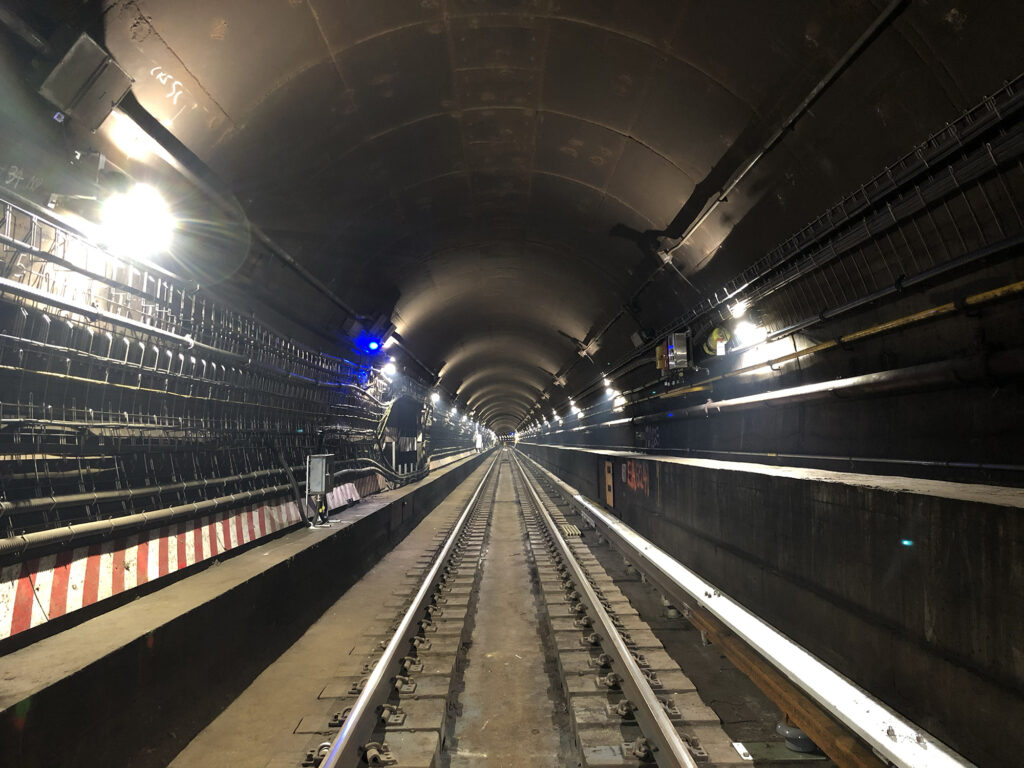
Capital budgets face real constraints. Signals, rolling stock, stations, accessibility: tunnel lighting competes with visible, high-priority investments. The American Society of Civil Engineers (ASCE) notes a $152 billion funding gap for U.S. transit infrastructure over the next decade.
But leading agencies have stopped treating tunnel lighting as a standalone capital project.
The insight is simple. The real cost of tunnel work is track access and labor, not equipment. When crews are already in the tunnel for signals modernization, track replacement, or communications upgrades, the incremental cost to address lighting drops significantly.
Agencies bundling lighting into planned infrastructure work are finding a practical path to compliance without competing for dedicated capital allocation. It is not about making tunnel lighting a higher priority, it is about recognizing when the window is already open.
What’s Working: Approaches from Recent Deployments
Three approaches are delivering results:
Remote monitoring that supports maintenance planning. Wireless monitoring provides real-time visibility into battery health, power status, and fixture function across tunnel networks without requiring hardwired infrastructure. Teams identify exactly which fixtures need attention before entering the tunnel, enabling predictive maintenance and better use of limited track access.
Dual-function lighting that consolidates requirements. A single fixture provides code-compliant emergency egress lighting during normal operations and switches to OSHA-compliant work lighting when needed. No setup, no teardown, more productive track time.
Fixture-level battery backup that distributes resilience. Integrated batteries at each fixture (2- or 4-hour options) mean no single equipment failure affects an entire tunnel section. This approach can also reduce the need for fire-rated cable retrofits in legacy applications. Modern systems designed for rapid installation fit naturally into projects already on the capital plan. The implementation burden is far lighter as part of scheduled track access rather than a dedicated mobilization.
METRIC
ENERGY EFFICIENCY
LIGHT UNIFORMITY
FIXTURE LIFESPAN
INSTALLATION
PERFORMANCE
12 watts achieving 2.5 fc vs 56 watts for legacy fixtures
3:1 ratio vs 50:1 + for legacy systems
10-15 years with military-grade batteries
Plug-and-play (2 screws, quick splice to junction box)
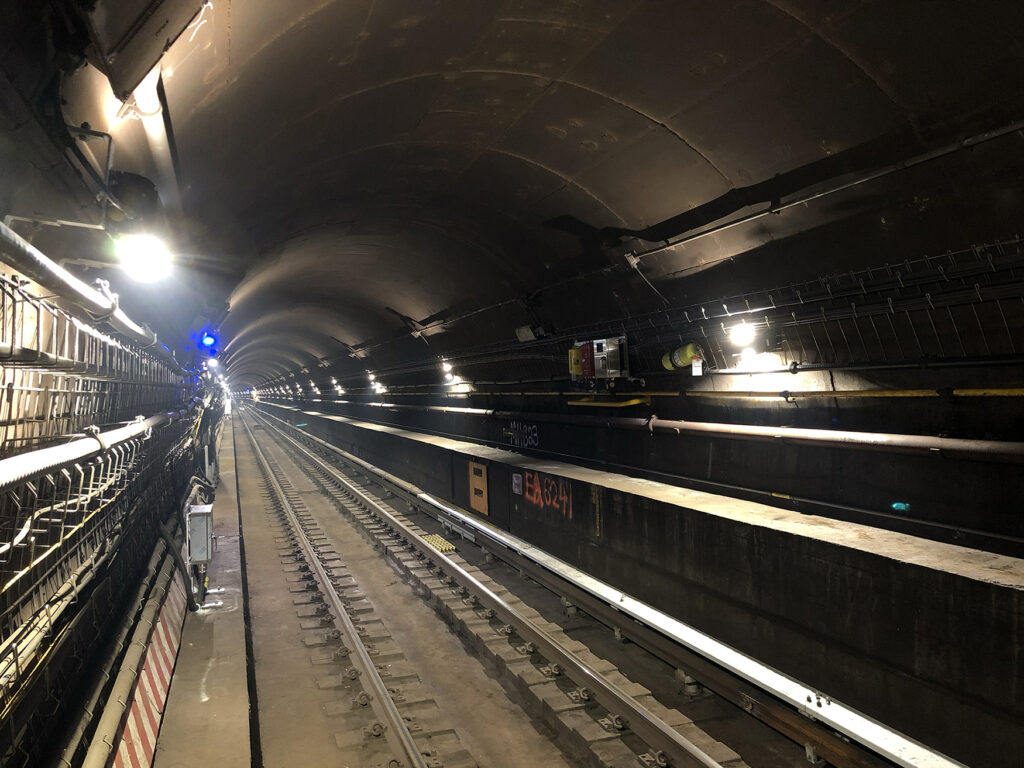
These performance metrics reflect systems designed to exceed NFPA 130 minimums and meet the higher illumination standards progressive agencies are adopting. Projected savings on a 660-fixture under-river tunnel deployment (9,900 linear feet): $2.7 million over ten years from reduced maintenance labor, eliminated temporary lighting costs, and lower energy consumption.
The Case for Bundling
Tunnel emergency lighting sits at the intersection of three pressures that are not going away: evolving regulatory requirements, constrained capital budgets, and the operational reality of limited track access windows.
The traditional approach treats lighting as a standalone project competing for dedicated funding. That is a difficult path. Tunnel lighting rarely wins a head-to-head budget fight against signals, rolling stock, or station improvements.
The alternative reframes the question entirely. Instead of asking “when can we fund a lighting project,” the question becomes “what infrastructure work do we already have planned, and can lighting be part of the project(s)?”
This shift matters because it aligns with how transit capital programs actually work.
Signals modernization projects require extended tunnel access. Track replacement programs put crews underground for months. Communications upgrades touch the same infrastructure corridors. Each of these creates an opportunity to address lighting at marginal incremental cost.
The technology now exists to make that bundling practical. Fixtures designed for rapid installation; battery backup at the fixture level that eliminates complex wiring retrofits; wireless monitoring that reduces ongoing maintenance burden without adding cabling complexity.
These are not experimental capabilities; they are deployed and proven in transit environments today.
A Note on Longevity
For agencies facing the familiar tension between compliance requirements and budget realities, the path forward may already be on the capital plan. It is a matter of recognizing the opportunity and acting on it.
What Now? Questions for Your Next Planning Cycle

- When were your emergency lighting backup systems last tested under actual load?
- What is your light uniformity ratio at emergency circuit spacing?
- How much maintenance window time is invested into temporary lighting setup?
- Do you have signals, track, or communications projects that could accommodate a lighting component at minimal incremental cost?
- If an unplanned service interruption occurred in your longest tunnel segment, could riders safely self-evacuate with backup lighting that stays on long enough to reach an exit point?
- In a full-power-loss scenario, do your current fixtures provide the duration and illumination needed for a complete passenger evacuation out of tunnels?