Lessons from GPS and Mobile Banking for Paratransit’s Digital Future
By Kristoffer Vik Hansen | 2/11/2026
BY KRISTOFFER VIK HANSEN
CEO and Co-founder
Spare

Why is it that paratransit riders can track the location of a toothbrush as it gets shipped to their house but not their ride to an important medical appointment? They face this disconnect on a daily basis as they schedule appointments online, manage bank accounts from their phones, coordinate work shifts digitally and text friends and family throughout the day.
According to APTA, more than 6,300 paratransit systems deliver nearly 160 million trips annually. For each of those trips, there’s an opportunity to bridge the digital divide in paratransit, shifting focus from rider capability to how agencies can better align with where riders already are in their digital lives. Many agencies still assume self-serve booking will plateau at 20-25 percent of trips. But agencies that design deliberately for self-service across app, web, and AI voice channels are demonstrating that up to 80 percent of routine trips can be booked via self-serve, without eliminating phone support for riders who rely on it.
So, the issue facing the industry today isn’t whether paratransit riders are ready for digital tools. They’re already using them everywhere else. The real challenge is changing the industry mindset from whether digital self-serve will work to how agencies can achieve adoption rates that match what riders are already demonstrating in every other aspect of their lives.
Paratransit Riders Are Already Living Digitally (And Benefiting from It)
Today’s paratransit population is diverse, multi-generational and deeply embedded in the digital economy. Seventy-two percent of Americans with disabilities own a smartphone and 22.6 million individuals with disabilities in the U.S. fall within the 18-64 working-age population, significantly outnumbering those over 65. These same riders already rely on digital tools that have improved their daily independence. Mobile banking apps provide financial autonomy without requiring in-person visits. Food delivery platforms help manage unpredictable schedules around various appointments and work commitments. Telehealth brings doctors into homes, eliminating transportation barriers to care itself.
As a result, people with disabilities have gained independence in many areas, and now there’s an analogous opportunity to extend that same level of ease to transportation through thoughtful digital integration and adoption strategies.
The Change Starts with People
Agencies succeeding at modernizing their services are focusing on people and are adopting proven playbooks. For riders, the benefits are real: scheduling of rides without waiting on hold, making last-minute changes when appointments run long, and checking trip status in real time. For agencies, digital tools reduce routine call volume and allow staff to focus on complex, high-touch needs, including trip exceptions, rider training, and service recovery. Yet, it requires a real focus on rider journey and experience to ensure riders understand the new process and can learn at their pace.
Not every agency is starting from the same place. Some are piloting their first digital booking option, while others are refining mature systems. What they share is a recognition that the status quo no longer fully serves the needs of today’s riders or operational realities.
Modernizing Booking While Keeping Riders First
Agencies across the world that have embraced digital and automated booking channels are seeing positive outcomes not only in enhancing rider experience and autonomy but also in creating operational efficiencies that allow staff to focus on the most complex needs of their constituencies. By combining digital tools with high-touch support, broad outreach, and rider-centered strategies, agencies can both empower riders and strengthen service delivery.
Agencies that have seen strong results with digital modernization have employed approaches including:
- Phased rollouts to introduce digital booking alongside phone service
- Rider advisory groups that shape rollout strategy and messaging
- Travel training programs that include digital self-service as a core skill
- Staff engagement and internal alignment so digital tools are positioned as service enhancements, not threats
- Clear communication that emphasizes choice, not mandate
VoTran: A Model for Rider-Centered Digital Adoption
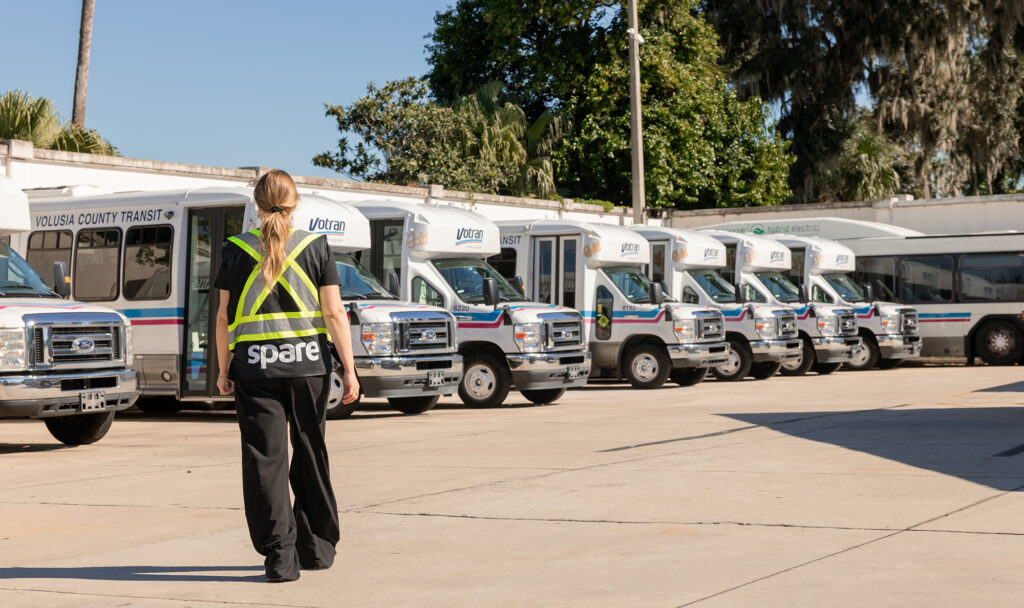
In Florida, Volusia County’s VoTran offers a compelling example for modernizing paratransit at full-county scale. Since implementing Spare’s platform, VoAccess has virtually eliminated late pickups, achieving 97 percent on-time performance. For riders, this represents the difference between daily uncertainty and reliable access to work, medical care, and essential services.
Not only did the county introduce mobile and web booking as an additional option, while maintaining phone support, but VoTran focused on rider education, gradual adoption, and operational readiness. It wasn’t technology alone that drove success. It was leadership alignment, realistic change management, and trust in riders’ ability to choose what works best for them.
As Angela Milroy, director of operations, RATP Dev USA puts it: “At RATP Dev USA, we know change isn’t just about new technology, it’s about people coming together with purpose. Partnering with Spare, we successfully launched a new paratransit and microtransit platform in Volusia County, giving our riders a faster and more reliable experience. Over two weeks of hands-on training, our local team worked side-by-side with Spare’s trainers to master new tools and workflows that are already improving service.”
Modernization Is a Shared Opportunity
Paratransit modernization means expanding dignity, flexibility, and control in a service area that supports the daily lives of millions of people.
Often the biggest barrier is the commitment to support behavioral change with digital tools for paratransit. Spare customers, which include some of the largest transit agencies in North America, have seen high adoption rates with self-serve booking with people-focused change management strategies.
Proven frameworks and agency implementations, like VoTran, demonstrate how digital tools can be introduced responsibly, accessibly, and at scale, without sacrificing reliability or rider trust. Riders are ready.
The future of paratransit is multi-channel, rider-driven, and agency-led, always ensuring that the regulations are adhered to. Modernization done right reflects confidence in riders and confidence in the industry’s ability to evolve.